


- What is the Mecca Joint Defence Agreement?
- Major Provisions of the Agreement
- Why was the Agreement Signed?
- Is it an “Islamic NATO”?
- The Nuclear Dimension
- Strategic Analysis
- Economic and Energy Implications for India
- Impact on India’s West Asia Policy
- What Should India Do?
- Potential Expansion of the Pact
- Conclusion
- UPSC CSE Mains Questions
The Mecca Joint Defence Agreement, signed on 7 August 2026 in Mecca by Saudi Arabia, Pakistan and Türkiye, is one of the most significant recent developments in the security architecture of West Asia and the wider Muslim world. The agreement emerged at a time of heightened geopolitical instability in the Middle East, growing concerns over missile and drone attacks, uncertainty surrounding traditional external security guarantees, and increasing attempts by regional powers to develop their own mechanisms of deterrence. The three countries have described the agreement as a defensive arrangement designed to strengthen collective security, deterrence and regional stability rather than as a pact directed against any particular country. Its most important provision is that an armed attack against any one of the three members will be regarded as an attack against all three, creating a principle of collective defence broadly comparable, at the level of political signalling, to the collective-defence principle associated with NATO.
It is important, however, not to confuse the 2026 Mecca Joint Defence Agreement with the earlier Saudi Arabia–Pakistan Strategic Mutual Defence Agreement of September 2025. The 2025 agreement was bilateral and involved Saudi Arabia and Pakistan, whereas the new Mecca agreement brings Türkiye into a trilateral security framework. The 2026 pact therefore represents a further institutionalisation and expansion of defence cooperation among the three countries.
🌐 Join Our Community
 Telegram Community
 WhatsApp Community
 YouTube Channel
 Instagram
 X (Twitter)
What is the Mecca Joint Defence Agreement?
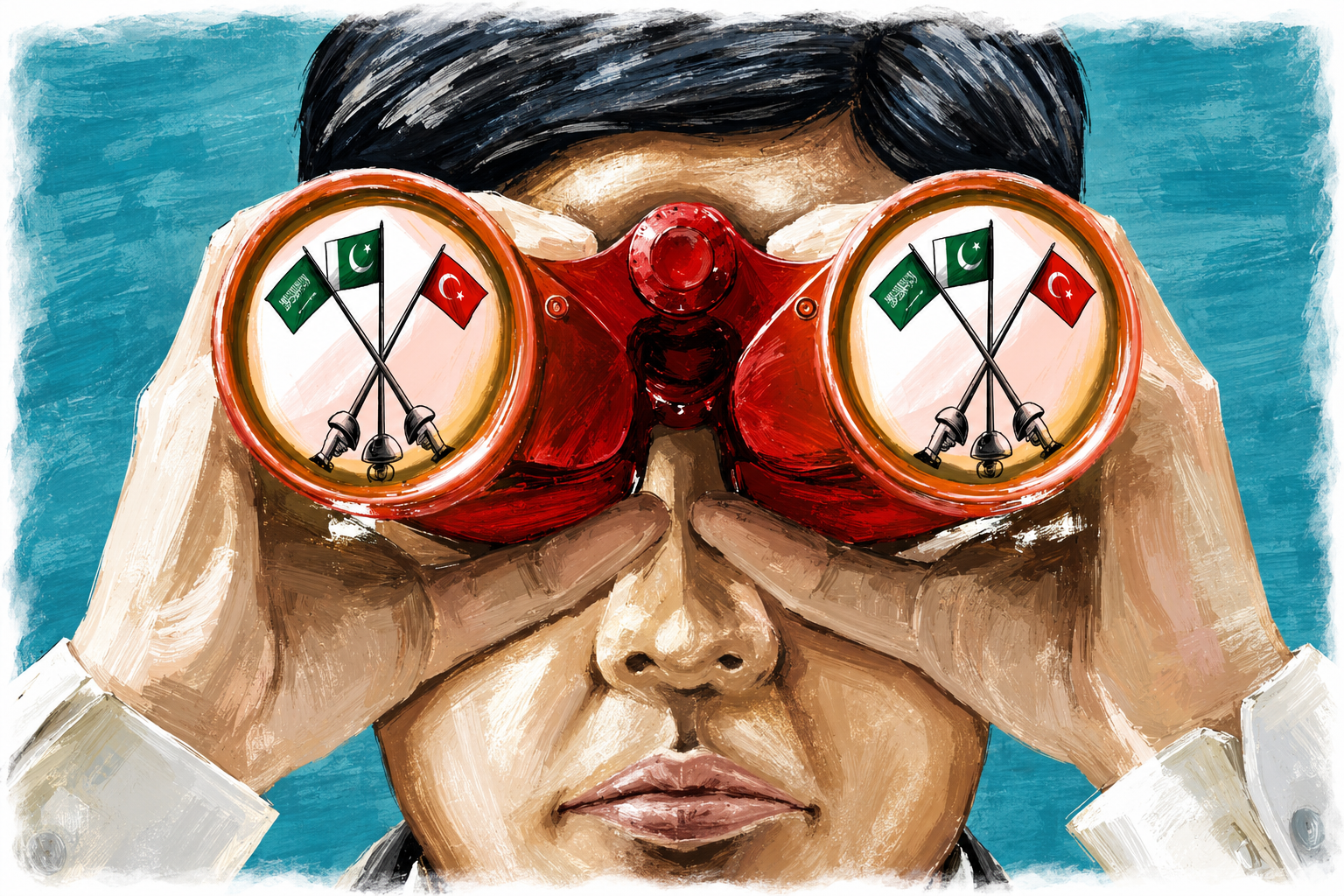
The Mecca Joint Defence Agreement is essentially a trilateral collective-security arrangement among Saudi Arabia, Pakistan and Türkiye. It seeks to convert their existing bilateral military and strategic relationships into a broader framework of cooperation. Saudi Arabia brings substantial financial resources, strategic geographical importance and influence in the Gulf; Pakistan contributes a large military establishment, extensive experience in regional security affairs and nuclear deterrence; while Türkiye contributes a powerful conventional military, NATO experience and an increasingly sophisticated defence-industrial base, particularly in areas such as drones and unmanned systems.
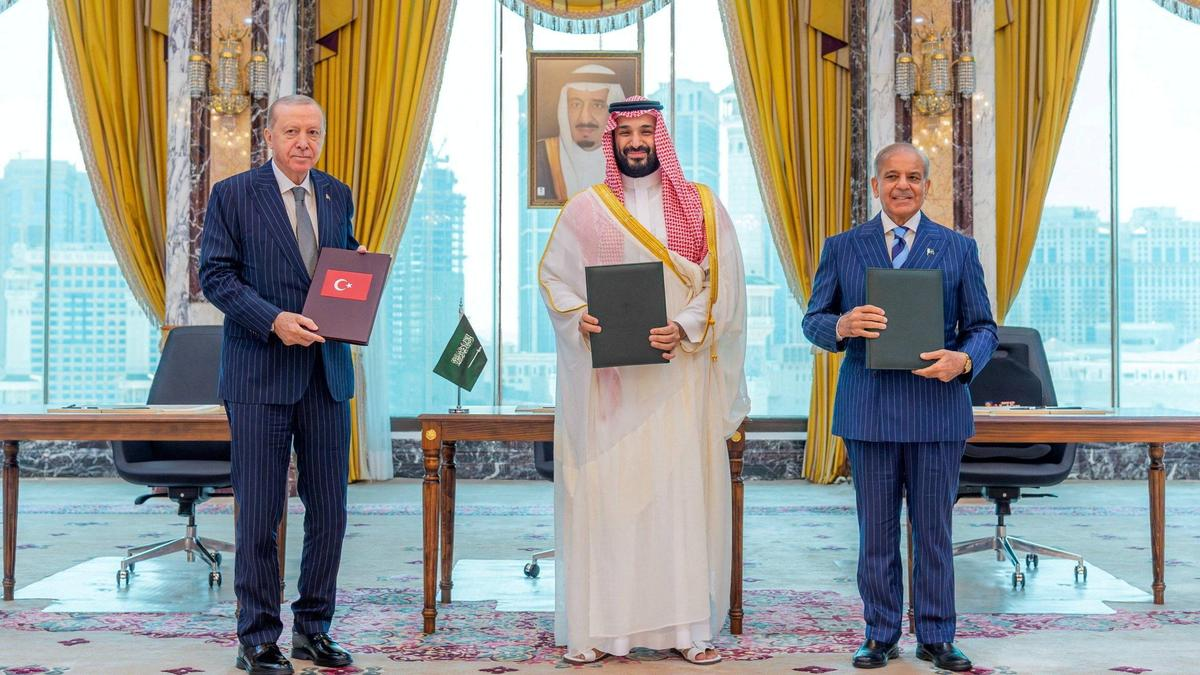
The agreement was signed during a summit in Mecca involving Saudi Crown Prince and Prime Minister Mohammed bin Salman, Turkish President Recep Tayyip Erdoğan and Pakistani Prime Minister Shehbaz Sharif. The participating countries presented the agreement as an instrument for strengthening collective deterrence and promoting peace, security and stability. The central principle is straightforward: if one member faces an armed attack, the attack is to be treated as an attack on all three members. The agreement also provides for broader defence cooperation, although the publicly available details do not establish an automatic and predetermined military response in every possible circumstance.
The agreement should therefore not immediately be equated with a fully developed “Islamic NATO”. The comparison is useful for understanding the collective-defence principle, but the institutional structures, military integration, command arrangements and operational commitments are not yet comparable to NATO. Analysts have consequently viewed the pact as both a security arrangement and a strategic signal whose practical strength will depend on how far the three countries translate political commitments into military interoperability and institutional mechanisms.
Major Provisions of the Agreement
The first and most important provision is collective defence. An armed attack against one of the three member states is to be considered an attack against all three. This creates a deterrent effect because a potential adversary must theoretically take into account the combined capabilities of Saudi Arabia, Pakistan and Türkiye rather than the capabilities of the individual country alone.
The second major provision is the enhancement of defence cooperation in multiple domains. The agreement seeks to strengthen cooperation between the armed forces of the three countries and provide a framework for closer coordination in security matters. Türkiye has indicated that the arrangement can involve regular interaction between senior political and military leadership and the creation of mechanisms for sustained strategic coordination.
A third area is joint military exercises and greater interoperability. Reporting on the agreement indicates an emphasis on cooperation across land, maritime, air and cyber domains. Such exercises can help the three militaries develop common procedures, improve communication and increase their ability to operate together during a crisis. Cooperation in emerging technologies such as unmanned systems, electronic warfare and artificial intelligence has also been highlighted.
The fourth important component is defence-industrial cooperation. Türkiye has developed a strong indigenous defence industry, particularly in drones and other advanced military technologies. Saudi Arabia, meanwhile, has been seeking to develop domestic defence-production capabilities, while Pakistan possesses considerable experience in military production and defence technology. Cooperation among these three could therefore involve joint production, technology transfer, research and development and defence-industry partnerships.
Another important feature is its counter-terrorism and security dimension. Turkish President Erdoğan described the agreement as contributing to defence-industry cooperation and the fight against terrorism. This gives the pact a broader security dimension beyond conventional interstate warfare.
The agreement also appears to leave the door open for future expansion. Türkiye has indicated that countries such as Egypt could potentially become part of the emerging framework. If additional important Arab or Muslim-majority states join, the agreement could evolve from a trilateral arrangement into a broader regional security mechanism. However, expansion would also introduce new political differences and strategic complications.
Why was the Agreement Signed?
The pact needs to be understood against the background of a rapidly changing Middle Eastern security environment. Gulf countries have increasingly faced missile, drone and maritime-security threats, while the wider region has experienced conflicts involving Iran, Israel, armed non-state actors and competing regional powers. The uncertainty surrounding the reliability and future direction of external security guarantees has encouraged regional states to explore greater strategic autonomy.
For Saudi Arabia, the agreement provides an additional layer of deterrence. Riyadh has traditionally depended heavily on external military partnerships, particularly with the United States, but it has simultaneously attempted to strengthen its own strategic capabilities and diversify its partnerships. A security relationship involving Pakistan and Türkiye gives Saudi Arabia access to two significant military powers with different but complementary capabilities.
For Pakistan, the agreement provides an opportunity to deepen its strategic role beyond South Asia. Pakistan has had a longstanding military relationship with Saudi Arabia, including the training and deployment of Pakistani military personnel in the Kingdom. Bringing Türkiye into the arrangement increases the geopolitical significance of this relationship and potentially strengthens Pakistan’s military and diplomatic position.
For Türkiye, the agreement fits into its broader effort to expand its strategic influence across the Middle East and Muslim world while strengthening defence-industrial partnerships. Türkiye’s growing defence industry, especially in unmanned systems, gives it an important role in any emerging regional security architecture.
📚 Explore More on Sociologus
Is it an “Islamic NATO”?
The expression “Islamic NATO” has gained popularity because of the pact’s collective-defence provision. However, the term should be used cautiously. NATO is supported by highly developed institutional structures, integrated military planning, established command systems, extensive interoperability and decades of operational experience. The Mecca agreement does not yet possess a comparable institutional architecture.
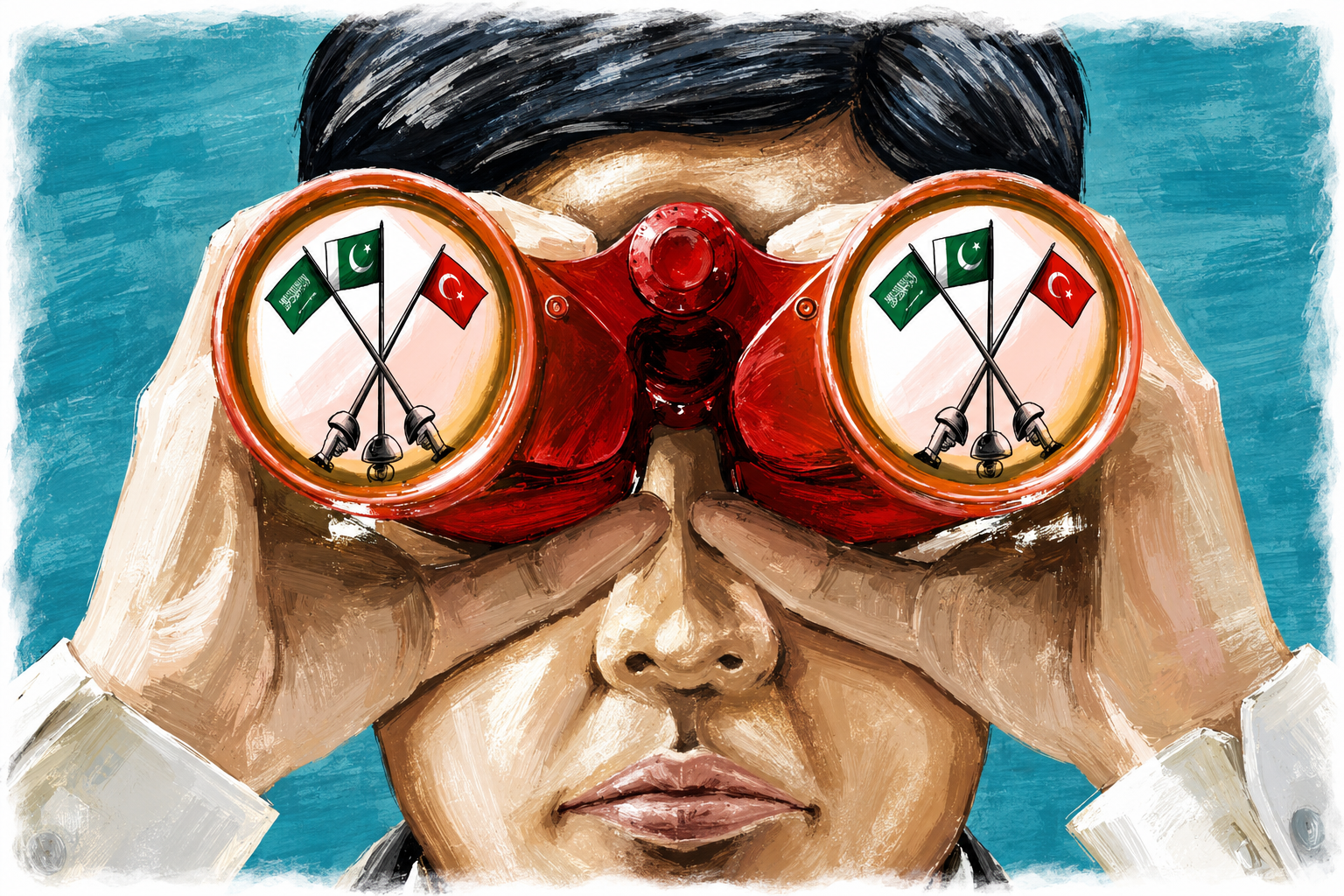
The three countries themselves have emphasised that the agreement is defensive and is not directed against any particular state. Türkiye has specifically stated that the agreement does not target Iran or another country. Saudi officials have also rejected the idea that the pact represents a sectarian military bloc or a nuclear project.
Therefore, it is better to describe the Mecca agreement as an emerging regional collective-security framework rather than simply calling it an “Islamic NATO”. Its ultimate importance will depend on whether the three members develop permanent institutions, intelligence-sharing mechanisms, joint exercises, defence production, coordinated military planning and credible procedures for responding to an actual attack.
The Nuclear Dimension
The inclusion of Pakistan naturally creates questions about the nuclear dimension of the agreement. Pakistan is the only nuclear-armed member of the three-country grouping, and therefore the collective-defence arrangement has attracted speculation about whether Pakistan’s nuclear deterrent could indirectly extend to Saudi Arabia.
However, it is important to distinguish political speculation from the publicly established provisions of the agreement. The publicly announced pact does not explicitly establish a nuclear-sharing arrangement or announce the transfer of nuclear weapons to Saudi Arabia. Saudi officials have specifically stated that the agreement is not connected to nuclear ambitions or an arms race.
Nevertheless, Pakistan’s nuclear status gives the agreement an additional strategic dimension. Even without formal nuclear sharing, the perception that Pakistan’s strategic capabilities are connected to Saudi security could increase the deterrent value of the arrangement. At the same time, excessive ambiguity regarding nuclear commitments could create instability and raise concerns about proliferation and escalation in an already volatile region.
Strategic Analysis
The most important significance of the Mecca agreement is that it represents a movement towards regionalisation of security. For decades, the security architecture of the Gulf and wider Middle East depended substantially on external powers, especially the United States. The new agreement indicates that regional powers increasingly want to develop their own mechanisms of deterrence and crisis management.
The second significance is the combination of complementary capabilities. Saudi Arabia possesses financial strength, energy resources and strategic influence in the Gulf. Türkiye possesses a large conventional military and an expanding defence industry. Pakistan possesses a large military establishment, nuclear deterrence and extensive experience in South Asian and Middle Eastern security affairs. The combination creates a partnership with considerable political and military weight.
The third significance is the possibility of defence-industrial integration. If Saudi capital, Turkish defence technology and Pakistani military expertise are combined, the three countries could potentially develop new defence-production and technology partnerships. This could reduce dependence on Western suppliers over the long term and strengthen indigenous military capabilities.
The fourth significance is strategic signalling. The pact sends a message that Saudi Arabia, Pakistan and Türkiye are prepared to cooperate more closely when their security interests converge. At the same time, the agreement provides its members with greater bargaining power in relations with larger external powers.
However, the agreement also has limitations. The three countries do not have identical strategic interests. Pakistan’s principal security concerns are heavily concentrated in South Asia, Saudi Arabia is primarily concerned with Gulf and Middle Eastern security, while Türkiye has interests extending from the Middle East to the Mediterranean, Caucasus and beyond. Therefore, a military crisis involving one member may not necessarily be viewed in the same way by the other two.
There is also a question of military interoperability. Saudi Arabia operates significant Western-origin equipment, Pakistan relies heavily on Chinese and indigenous systems, while Türkiye has developed a mixture of domestic and NATO-compatible systems. Integrating these systems into a common operational framework would be difficult and would require sustained investment.
Thus, the agreement is currently more significant as a political-strategic framework and deterrence mechanism than as a fully integrated military alliance.
Impact on India
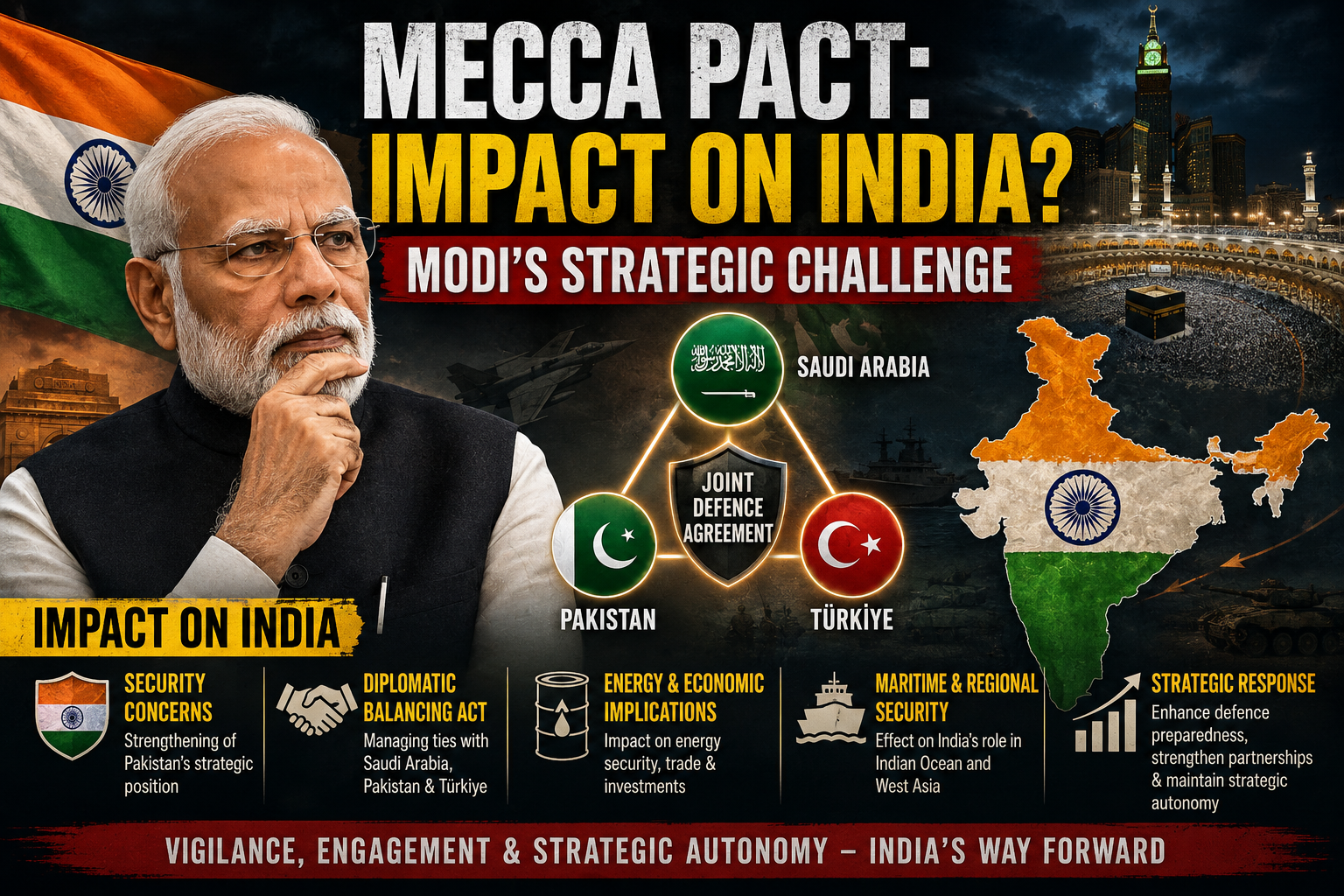
For India, the Mecca Joint Defence Agreement is important because it brings together Pakistan and two major West Asian powers with which India has significant economic, diplomatic and strategic relations. The development therefore creates a delicate balancing challenge for New Delhi. The immediate concern is Pakistan. India and Pakistan remain strategic rivals, and Pakistan’s participation means that any expansion of its military and diplomatic influence through the agreement has to be carefully monitored by India. The collective-defence clause could potentially make Pakistan more confident because it knows that a military crisis involving it may have wider regional diplomatic consequences. However, it would be premature to assume that Saudi Arabia or Türkiye would automatically support Pakistan in every India-Pakistan conflict. The agreement has not publicly identified India as an adversary and has been presented as a general defensive arrangement.
The second concern relates to Türkiye’s role. Türkiye has already developed close defence and political relations with Pakistan and has at times taken positions on issues important to India, particularly Kashmir. Its inclusion in the pact therefore gives Pakistan another avenue for strategic cooperation. The possibility of deeper defence-industrial cooperation between Türkiye and Pakistan could also have implications for India’s security calculations.
The third concern is Saudi Arabia. Saudi Arabia is not merely another Middle Eastern state for India. It is an important energy supplier, investment partner, trading partner and destination for a large Indian diaspora. India therefore cannot afford to interpret the Mecca pact solely through the India-Pakistan lens. New Delhi has to preserve its strategic relationship with Riyadh while simultaneously ensuring that Saudi-Pakistani military cooperation does not adversely affect Indian security interests.
India’s response to the earlier Saudi-Pakistan defence agreement in 2025 is instructive. The Ministry of External Affairs emphasised that India and Saudi Arabia have a wide-ranging strategic partnership and stated that it expected this partnership to take into account India’s “mutual interests and sensitivities.” India also said it would study the implications of the development for its national security and regional and global stability.
The 2026 response has remained similarly measured. Rather than making an aggressive diplomatic statement, India has indicated that it is examining the implications of the new Mecca pact for national security and regional stability. This reflects India’s preference for strategic autonomy, diplomatic engagement and issue-based partnerships rather than entering into a counter-alliance simply because another regional grouping has emerged.
Economic and Energy Implications for India
The economic dimension is equally important. Saudi Arabia is a major energy partner for India and plays an important role in India’s crude-oil supply chain. The Kingdom is also an important destination for Indian workers and an increasingly significant source of investment.
India’s economic interests therefore provide a strong incentive for maintaining stable relations with Riyadh. A deterioration in India-Saudi relations could have consequences for energy security, remittances, investment and trade. This explains why India’s response has been cautious rather than confrontational.
The pact could also affect India’s wider connectivity ambitions. India has sought to strengthen connectivity between India, the Gulf and Europe through initiatives such as the India-Middle East-Europe Economic Corridor. A stable and cooperative relationship with Saudi Arabia remains important for such connectivity projects. Consequently, New Delhi has an interest in preventing geopolitical competition from becoming so intense that it disrupts economic integration.
Impact on India’s West Asia Policy
The Mecca agreement reinforces the importance of India’s Act West Policy. India can no longer approach West Asia primarily as an energy source and labour destination. The region is increasingly becoming an arena of strategic competition involving the United States, China, Iran, Israel, Türkiye, Saudi Arabia and other regional powers.
India therefore needs to maintain strong bilateral relations with all major regional actors wherever possible. Its relationship with Saudi Arabia must continue to deepen in areas such as energy, investment, counter-terrorism, maritime security and technology. At the same time, India must carefully manage its relations with Türkiye and remain alert to the growing Pakistan-Türkiye defence relationship.
The appropriate Indian response is therefore not to create an “anti-Mecca” alliance but to pursue strategic diversification. India can strengthen its defence preparedness, maritime surveillance, intelligence capabilities and diplomatic engagement while simultaneously expanding economic interdependence with Gulf countries.
What Should India Do?
India should first avoid overreacting. The Mecca agreement should not automatically be interpreted as an anti-India alliance because its members have publicly stated that it is defensive and does not target a particular country.
Second, India should deepen its strategic partnership with Saudi Arabia. Regular high-level political dialogue, defence cooperation, counter-terrorism coordination, energy partnerships and investment should be expanded. Strong economic interdependence can ensure that India-Saudi relations remain resilient despite Saudi Arabia’s defence relationship with Pakistan.
Third, India should strengthen maritime security cooperation with Gulf states. The security of the Arabian Sea, Persian Gulf, Strait of Hormuz, Red Sea and wider Indian Ocean has direct implications for India’s trade and energy security.
Fourth, India should carefully monitor Pakistan-Türkiye defence cooperation, particularly in drones, missiles, electronic warfare and other advanced military technologies. The objective should be enhanced preparedness rather than unnecessary escalation.
Fifth, India should continue its policy of multi-alignment and strategic autonomy. New Delhi has demonstrated that it can simultaneously maintain partnerships with the United States, Russia, Israel, Iran, Saudi Arabia, the UAE and other major powers. The emergence of a new regional bloc makes this flexibility even more valuable.
Potential Expansion of the Pact
One of the most important questions for the future is whether the Mecca agreement will remain trilateral or develop into a wider regional framework. Türkiye has indicated that other countries, particularly Egypt, could potentially join.
If countries such as Egypt or other major regional powers eventually become members, the strategic significance of the arrangement would increase considerably. A larger grouping could facilitate intelligence-sharing, joint military exercises, defence production and coordinated responses to regional crises.
However, expansion would also make decision-making more difficult. Different members would have different relations with Iran, Israel, the United States, Russia and China. Some countries may also be unwilling to become part of a formal military bloc. Therefore, expansion is possible, but transforming the pact into a cohesive collective-security organisation will be a difficult process.
Conclusion
The Mecca Joint Defence Agreement of 2026 represents an important development in the changing security architecture of West Asia. Its central principle — that an armed attack against one member will be regarded as an attack against all — provides the agreement with a strong collective-deterrence character. The participation of Saudi Arabia, Pakistan and Türkiye brings together financial power, military capability, technological capacity and nuclear deterrence within a single strategic framework.
However, it would be premature to describe the pact simply as an “Islamic NATO”. Its real effectiveness will depend on institutionalisation, joint military exercises, intelligence cooperation, defence-industrial integration and the willingness of the three countries to act collectively during an actual crisis. The agreement is therefore best understood as an emerging regional security framework and a strategic signal of greater regional self-reliance.
For India, the pact presents both challenges and opportunities. Pakistan’s participation creates a security concern, Türkiye’s involvement adds another layer to the India-Pakistan strategic equation, and Saudi Arabia’s closer military relationship with Pakistan requires careful diplomatic management. At the same time, India’s deep economic and strategic partnership with Saudi Arabia provides New Delhi with significant diplomatic space. India’s best response is therefore neither confrontation nor complacency, but strategic vigilance combined with deeper engagement with the Gulf, stronger maritime and defence capabilities, and continued strategic autonomy.
In the broader perspective, the Mecca pact reflects a major transformation in international politics: regional powers are increasingly unwilling to remain passive consumers of security provided by external powers and are attempting to build their own mechanisms of deterrence and strategic cooperation. For India, this underlines the growing importance of West Asia as part of India’s extended neighbourhood and as a critical component of its national-security, energy, economic and connectivity interests.
The Mecca Joint Defence Agreement can be analysed through the themes of West Asian geopolitics, collective security, strategic autonomy, India-Saudi relations, India-Pakistan relations, defence diplomacy, energy security, maritime security, regionalisation of security and the changing global order.
UPSC CSE Mains Questions
1. “The Mecca Joint Defence Agreement marks a shift towards greater regionalisation of security in West Asia.” Discuss its major provisions and analyse its implications for the changing geopolitical architecture of the region. (15 Marks, 250 Words)
2. “The Mecca Joint Defence Agreement presents India with both strategic challenges and diplomatic opportunities.” Examine its potential impact on India’s relations with Saudi Arabia, Pakistan and Türkiye, and suggest an appropriate Indian response. (10 Marks, 150 Words)
Sources/Credit: The Indian Express | The Hindu | Wikipedia
Compiled & analysed for educational purposes by Sociologus.com