


Introduction
Karl Marx regarded capitalism as a mode of production based on private ownership of the means of production, wage labour and production for profit. It transformed traditional social relations and became a major force of social change. Its impact on society has been both progressive and exploitative.
Main Body
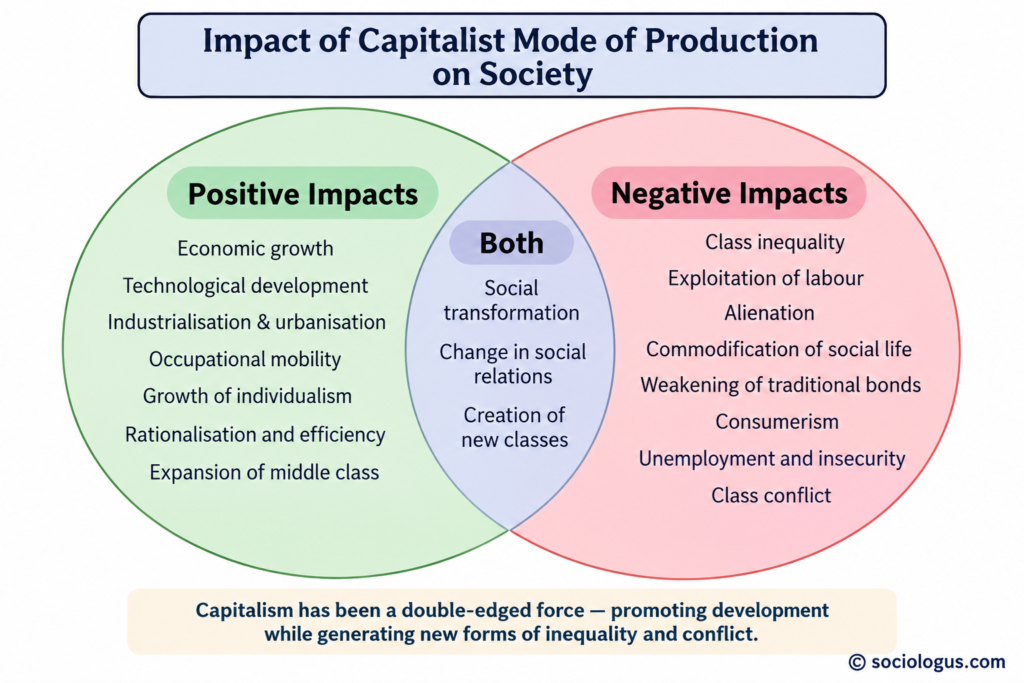
Positive Impacts of Capitalism
- Rapid economic growth : Capitalism promotes investment, competition and accumulation of capital, leading to increased productivity and economic expansion.
- Technological development: The pursuit of profit encourages innovation and mechanisation.
- Marx: Capitalism has an unprecedented capacity to revolutionise the means of production.
- Urbanisation and industrialisation : Factory production led to the growth of cities and modern industrial societies.
- Example: Industrial cities such as Mumbai, Manchester.
- Occupational and social mobility : Traditional status hierarchies weakened, allowing individuals to acquire positions through education, occupation and economic achievement.
- Example: Expansion of professional and managerial classes.
- Growth of individualism : Capitalism strengthened individual choice, contractual relationships and personal economic freedom.
- According to Tonnies Movement from Gemeinschaft to Gesellschaft reflects this transition.
- Rationalisation of economic life : Max Weber associated capitalism with calculability, efficiency, discipline and bureaucratic organisation.
Negative Impacts of Capitalism
- Class inequality : Capitalism divides society primarily between bourgeoisie, who own the means of production, and proletariat, who sell their labour. This produces structural inequalities in wealth and power.
- Exploitation of labour : According to Marx, capitalists appropriate surplus value created by workers.
- Example: Low wages despite high productivity in labour-intensive industries.
- Alienation : Workers become alienated from,
- Product of labour
- Process of production
- Fellow workers
- Their own human potential
- Commodification of social life : Increasing areas of life become subject to market exchange.
- Example: Education, healthcare and care work increasingly being treated as commodities. Eg : High Costs.
- Weakening of social bonds : Market relations can replace traditional community based relationships with impersonal and contractual relations.
- Consumerism : Capitalist production creates a continuous demand for consumption.
- Example: Advertising driven lifestyles and status consumption.
- Economic insecurity and unemployment : Competition and technological change may generate unemployment and precarious employment.
- Marx: The capitalist system produces a “reserve army of labour.“
Conclusion
The capitalist mode of production has been a double edged force of social transformation. As Marx recognised, it has revolutionised production, technology and social relations, but simultaneously generated exploitation, alienation and inequality. Contemporary capitalism has moderated some of these contradictions through labour rights, welfare states and regulation, yet the tension between economic growth and social justice continues to remain central to modern society.