

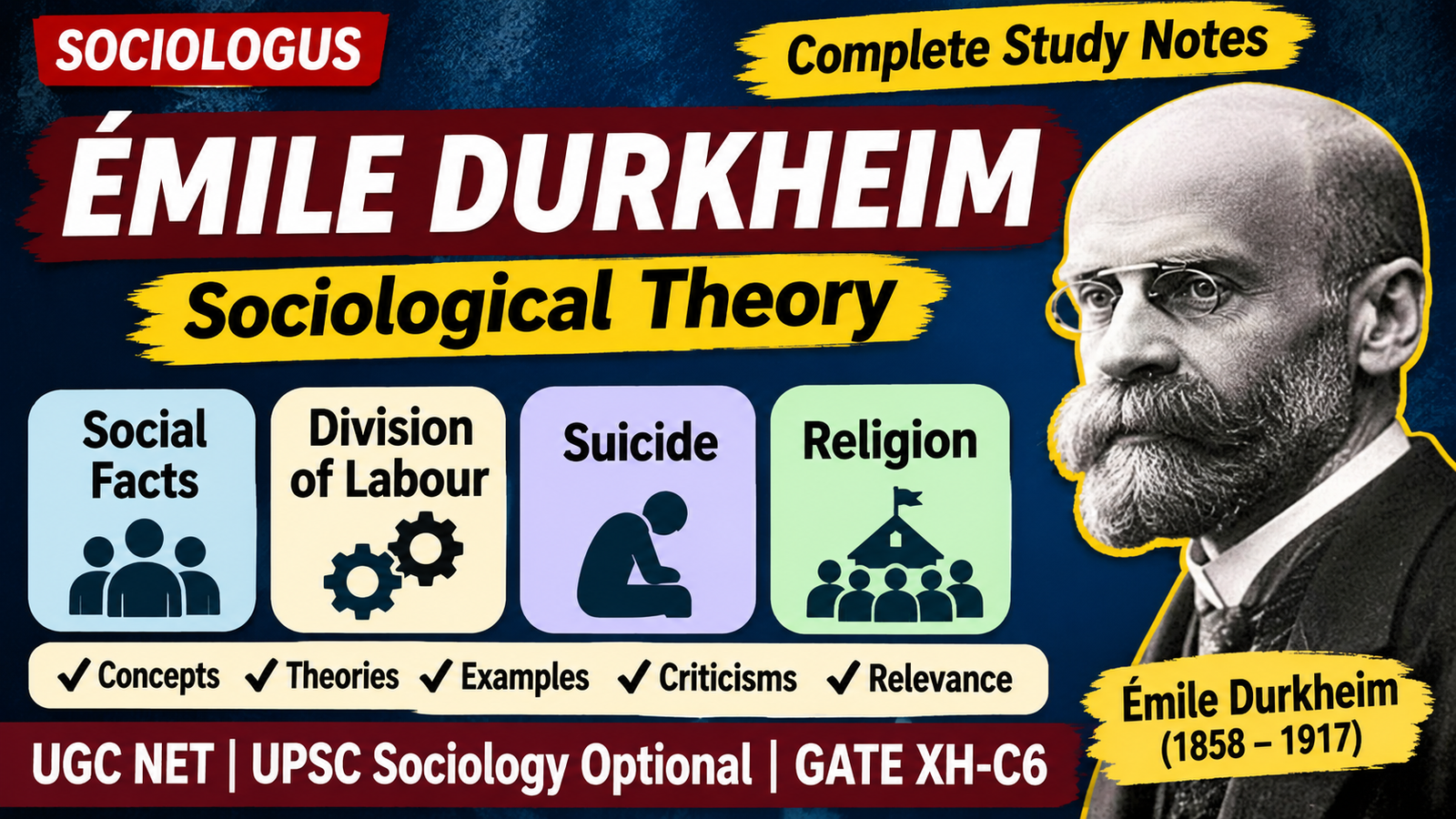

For UGC NET Sociology | UPSC CSE Sociology Optional | GATE Sociology XH-C6
1. INTRODUCTION TO EMILE DURKHEIM
Emile Durkheim (1858–1917) was a French sociologist and one of the founding fathers of modern sociology. He played a crucial role in establishing sociology as an independent scientific discipline.
Durkheim attempted to understand how society maintains order, stability and solidarity despite increasing modernization, industrialization and individualism.
His central argument was that society is not merely an aggregate of individuals. Rather, it is a reality in itself, possessing its own structures, institutions, values and norms that influence individual behavior.
Major Contributions and Works
| Year | Major Work | Central Theme |
|---|---|---|
| 1893 | The Division of Labour in Society | Social solidarity and modernisation |
| 1895 | The Rules of Sociological Method | Social facts and scientific methodology |
| 1897 | Suicide | Social integration and regulation |
| 1912 | The Elementary Forms of Religious Life | Religion and collective consciousness |
Central Sociological Concerns
- How is social order maintained in society?
- What holds individuals together in modern societies?
- How do social structures influence individual behavior?
- What happens when social norms and institutions weaken?
- How does religion create collective identity and solidarity?
Durkheim’s sociology primarily belongs to the structural-functionalist tradition, although his work predates the formal development of functionalism.
2. SOCIAL FACTS
2.1 Meaning and Definition
Social facts are one of the most important concepts in Durkheim’s sociology.
According to Durkheim, social facts are ways of acting, thinking and feeling that exist outside individuals and exercise coercive power over them.
In simple terms, social facts are established social patterns that influence how individuals behave, think and interact within society.
For example, language, religion, customs, laws, marriage practices and moral values exist before an individual is born. Individuals enter an already established social world and learn to follow its rules.
Central Argument: Society shapes individuals through social facts rather than individuals independently creating every aspect of social life.
2.2 Characteristics of Social Facts
1. Externality
Social facts exist outside individual consciousness.
They are not created by a single individual but are inherited from society.
For example, an individual does not invent the Hindi or English language. They learn an already existing linguistic system.
2. Cohesiveness
Social facts exercise pressure on individuals to conform to established norms and expectations.
This coercion may be formal or informal.
Formal coercion: Legal punishment for violating laws.
Informal coercion: Social criticism, disapproval, ridicule or exclusion for violating customs.
For example, an individual who refuses to follow established dress conventions may face social criticism.
3. Generality
Social facts are widespread across a particular society or social group.
For example, marriage customs, religious practices and language are shared by large sections of a population.
However, generality alone does not make something a social fact. Its external and coercive character is also important.
4. Independence from Individual Will
Social facts exist independently of individual preferences.
An individual may disagree with a particular law or custom, but that does not automatically eliminate its existence.
For example, an individual cannot independently abolish the institution of marriage or change an entire legal system.
5. Social Origin
Social facts originate in collective life and social interaction.
They represent established patterns of social organization rather than purely individual experiences.
2.3 Types of Social Facts
Durkheim’s sociology allows us to distinguish between material and non-material social facts.
A. Material Social Facts
Material social facts are tangible social structures and institutions that can be observed directly.
Examples:
- Legal systems and laws.
- Government and administrative institutions.
- Population density.
- Social organization.
- Institutional structures.
- Architecture and urban arrangements.
These structures influence the opportunities, relationships and behavior of individuals.
Example: The organization of urban housing influences patterns of interaction, community life and social segregation.
B. Non-Material Social Facts
Non-material social facts are intangible social forces that shape individual consciousness and behavior.
Examples:
- Collective consciousness.
- Social norms.
- Values and beliefs.
- Religious morality.
- Customs and traditions.
- Collective representations.
Example: Patriarchal norms may influence gender roles, marriage practices and the division of domestic responsibilities.
Important distinction: Material social facts represent the structural dimensions of society, whereas non-material social facts represent its moral, cultural and normative dimensions.
2.4 Collective Consciousness
Collective consciousness refers to the shared beliefs, values, attitudes and moral sentiments held by members of a society.
It provides a common framework through which individuals understand right and wrong, acceptable and unacceptable behavior.
In traditional societies, collective consciousness is relatively strong and extensive because individuals share similar occupations, beliefs and lifestyles.
In modern societies, the increasing division of labor produces greater occupational specialization and individual differentiation. Consequently, collective consciousness becomes relatively less extensive.
However, it does not disappear.
Example: Constitutional values, national identity and common civic norms can provide collective moral foundations in modern societies.
2.5 Rules of Sociological Method (1895)
Durkheim argued that sociology must study social facts scientifically and objectively.
His central methodological principle was:
“Treat social facts as things.”
This means sociologists should examine social facts as external realities rather than interpreting them through personal opinions or assumptions.
Major Methodological Principles
1. Treat social facts as things
Social facts should be investigated as objective phenomena. Researchers must not assume that their personal understanding represents the actual nature of social reality.
2. Avoid preconceptions
Sociologists should avoid allowing personal beliefs, moral judgments and ideological assumptions to influence research.
3. Observe empirical evidence
Social phenomena should be examined through observable evidence such as statistics, laws, institutions and social practices.
4. Explain social facts through other social facts
Durkheim argued that the determining cause of a social fact should be sought among antecedent social facts rather than exclusively in individual psychology or biology.
5. Examine social functions
Researchers should distinguish between the cause of a social phenomenon and the function it performs in society.
For example, the cause of the development of a particular institution may differ from the function it performs in maintaining social order.
Example: Study of Suicide
Instead of explaining suicide only through individual depression or personal difficulties, Durkheim investigated variations in suicide rates across religious communities, marital conditions and levels of social integration.
This helped establish suicide as a legitimate subject of sociological investigation.
2.6 Criticism of Social Facts
Max Weber
Weber argued that sociology must understand the subjective meanings individuals attach to their actions. Durkheim’s emphasis on external social structures gives insufficient attention to individual interpretation.
George Herbert Mead
The interaction perspective highlights how social reality is continuously created and reconstructed through interaction.
Anthony Middens
Middens’ structuration approach attempts to overcome the opposition between social structure and individual agency by explaining their mutual constitution.
General Criticism
- Excessive emphasis on social structures.
- Underestimation of individual agency.
- Difficulty separating social and psychological influences.
- Risk of deterministic explanations.
- Limited attention to subjective meanings.
2.7 Contemporary Relevance
Social facts remain useful for understanding contemporary social problems.
Education: Examination systems, institutional rules and educational expectations shape students’ behavior.
Gender: Patriarchal norms influence gender roles and opportunities.
Digital society: Social media norms, online reputational pressures and algorithmically structured interactions influence individual behavior.
Public health: Social norms influence vaccination, sanitation and health-related practices.
Social policy: Understanding social facts helps policymakers address structural causes of problems such as unemployment, crime and educational inequality.
UPSC Answer-Writing Insight
Durkheim establishes that individual behavior cannot be understood independently of society. However, a comprehensive sociological explanation must also consider agency, interpretation and changing social relationships.
3. DIVISION OF LABOUR IN SOCIETY
3.1 Meaning and Definition
Division of labor refers to the specialization of different individuals or groups in different occupational and social activities.
Durkheim examined how increasing occupational specialization transforms the nature of social relationships and creates new forms of solidarity.
His central argument was that the division of labor is not merely an economic phenomenon. It is also a moral and social phenomenon because it creates interdependence among individuals.
For example, a doctor, farmer, teacher, engineer and administrator perform different functions, but each depends on the services of others.
Thus, specialization creates relationships of mutual dependence.
3.2 Division of Labor: Traditional and Modern Societies
Durkheim compared traditional and modern societies to explain the transformation of social solidarity.
A. Traditional Societies
Traditional societies are characterized by relatively limited occupational specialization.
Individuals perform similar activities and share common beliefs, values and lifestyles.
Characteristics:
- Low division of labor.
- Similarity in occupations and lifestyles.
- Strong collective consciousness.
- Limited individual differentiation.
- Mechanical solidarity.
- Predominantly repressive law.
Example: Small traditional communities where economic activities, customs and religious practices are commonly shared.
B. Modern Societies
Modern societies are characterized by extensive occupational specialization.
Individuals perform different activities and become dependent on the specialized services of others.
Characteristics:
- High division of labor.
- Occupational specialization.
- Greater individual differentiation.
- Relatively less extensive collective consciousness.
- Organic solidarity.
- Predominantly restitutive law.
Example: Modern industrial and urban societies where production, administration, healthcare, education and technology depend on specialized institutions.
3.3 Mechanical Solidarity
Mechanical solidarity is a form of social solidarity based on similarity among members of society.
It is predominantly found in traditional societies where individuals share common occupations, beliefs, values and lifestyles.
Characteristics
- Similarity: Individuals perform similar economic and social activities.
- Strong collective consciousness: Common beliefs and values regulate behavior.
- Limited individualism: Individual identity is relatively less differentiated.
- Repressive law: Violations of collective morality are punished severely.
- Strong community bonds: Social relationships are based on shared identities and traditions.
Example: A traditional village community where members participate in similar religious festivals, agricultural activities and community practices.
Repressive Law
Repressive law involves punishment for actions that violate collective morality.
The primary objective is to punish the offender and reaffirm the authority of collective consciousness.
Example: Criminal punishment for acts considered serious violations of shared social values.
3.4 Organic Solidarity
Organic solidarity is a form of social solidarity based on interdependence among specialized individuals and institutions.
It is predominantly associated with modern industrial societies.
The term organic is derived from the analogy of a living organism in which different organs perform specialized functions but depend on one another for survival.
Characteristics
- Occupational specialization: Individuals perform different tasks.
- Interdependence: Different occupations and institutions depend on each other.
- Individualism: Greater scope for individual identity and autonomy.
- Weaker extensive collective consciousness: Shared beliefs become less comprehensive.
- Restitution law: Legal systems increasingly focus on restoring social relationships and obligations.
Example: In a modern economy, farmers produce food, transport workers distribute it, retailers sell it and financial institutions facilitate transactions.
Each occupational group performs a distinct function but remains interconnected.
Restitution Law
Restitution law aims to restore the previous state of relationships or fulfill violated obligations rather than simply punish the offender.
Examples include civil law, contract law and administrative regulations.
3.5 Mechanical and Organic Solidarity: Comparison
| Basis | Mechanical Solidarity | Organic Solidarity |
|---|---|---|
| Society | Traditional | Modern |
| Division of labour | Low | High |
| Basis | Similarity | Interdependence |
| Collective consciousness | Strong and extensive | Relatively less extensive |
| Individualism | Limited | Greater |
| Law | Repressive | Restitutive |
| Occupations | Similar | Specialised |
| Social relationships | Based on likeness | Based on functional dependence |
3.6 Functions of Division of Labor
Durkheim considered division of labor an important source of social integration in modern societies.
1. Creates Social Interdependence
Occupational specialization makes individuals dependent on others for goods and services.
2. Promotes Organic Solidarity
Different individuals and institutions become connected through specialized functions.
3. Increases Productivity
Specialisation improves efficiency, expertise and the organization of production.
4. Encourages Cooperation
Different occupational groups must coordinate their activities to achieve common objectives.
5. Provides Social Roles
Individuals develop occupational identities and participate in the broader social organization.
6. Integrates Modern Society
Division of labor provides a mechanism through which complex societies maintain social cohesion despite increasing differentiation.
3.7 Abnormal or Pathological Forms of Division of Labor
Durkheim recognised that division of labor does not automatically produce solidarity.
Under certain conditions, occupational specialization can generate social disorganisation and inequality.
He identified three major abnormal forms.
A. Anomic Division of Labor
Anomic division of labor occurs when inadequate regulation and coordination exist between specialized occupations and economic activities.
The absence of appropriate rules produces uncertainty, conflict and weak social integration.
Example: Unregulated labor markets may produce insecurity, exploitation and unstable employment relationships.
B. Forced Division of Labor
Forced division of labor occurs when occupational positions are distributed through unequal social conditions rather than individual abilities and capacities.
Individuals may be prevented from accessing opportunities because of class, caste, gender or inherited privilege.
Example: Caste-based occupational restrictions can limit occupational mobility and reproduce unequal social opportunities.
C. Poor Coordination
This occurs when specialized occupational functions fail to coordinate effectively.
Different groups may operate independently without establishing the necessary relationships of cooperation.
Example: Lack of coordination between industrial management and workers may create industrial disputes and production disruptions.
3.8 Criticism of Durkheim’s Division of Labor
Karl Marx
Marx argued that division of labor under capitalism creates alienation, exploitation and class conflict.
Workers become separated from the products of their labor and lose control over the production process.
Thus, division of labor may reproduce capitalist domination rather than simply generate solidarity.
Max Weber
Weber’s analysis of bureaucracy highlights how increasing specialization and rationalisation can create rigid organisational structures and bureaucratic domination.
Conflict Perspective
Durkheim gives considerable importance to cooperation and social consensus but underestimates unequal power relations between occupational groups.
General Criticism
- Overemphasis on social harmony.
- Insufficient attention to class exploitation.
- Limited analysis of gendered and caste-based inequalities.
- Assumption that occupational interdependence necessarily produces solidarity.
- Insufficient attention to the autonomy of individuals.
3.9 Contemporary Relevance
Gig Economy: Platform-based workers depend on digital platforms but often experience employment insecurity and weak social protection.
Globalisation: Different countries specialise in production and services, creating international interdependence.
Digital Economy: Software engineers, data analysts, delivery workers and financial institutions perform specialized but interconnected functions.
Caste and Occupation: Caste-based occupational inequalities demonstrate how forced division of labor can restrict social mobility.
Industrial Relations: Poor coordination between employers and employees can produce conflict despite economic interdependence.
UPSC Answer-Writing Insight
Durkheim explains how occupational specialization creates organic solidarity. However, Marx reminds us that interdependence does not necessarily mean equality. Modern societies may experience both cooperation and structural exploitation.
4. SUICIDE: A SOCIOLOGICAL STUDY
4.1 Introduction
In 1897, Durkheim published his landmark work Suicide: A Study in Sociology.
The book is considered one of the earliest major demonstrations of how empirical research can be used to establish sociology as a scientific discipline.
Durkheim challenged the assumption that suicide is exclusively an individual or psychological phenomenon.
He argued that although suicide is committed by individuals, suicide rates reflect social conditions.
4.2 Definition of Suicide
Durkheim defined suicide as any death resulting directly or indirectly from a positive or negative act of the victim himself, which the victim knows will produce that result.
His central argument was that suicide should be studied as a social fact because suicide rates vary systematically across social groups and social conditions.
4.3 Objectives of Durkheim’s Study
- Establish sociology as a scientific discipline.
- Demonstrate the influence of social factors on individual behavior.
- Challenge purely psychological and biological explanations.
- Examine the relationship between social integration and suicide.
- Explain variations in suicide rates through comparative empirical research.
4.4 Methodology of Suicide
Durkheim employed a comparative and statistical approach.
1. Statistical Method
He collected and examined suicide statistics to identify patterns and variations across different social groups.
2. Comparative Method
He compared suicide rates across religious communities, marital conditions and social circumstances.
3. Social Facts
He treated suicide rates as objective social phenomena rather than focusing exclusively on individual cases.
4. Causal Analysis
He connected variations in suicide rates with differences in social integration and regulation.
5. Rejection of Extra-Social Explanations
He examined explanations based on psychological, biological, climatic and geographical factors and argued that these could not adequately explain the systematic variation in suicide rates.
4.5 Social Integration and Social Regulation
Durkheim explained suicide through two important dimensions.
A. Social Integration
Social integration refers to the degree to which individuals are connected to social groups and collective life.
Family, religion, community and occupational groups can provide emotional support and a sense of belonging.
Both insufficient and excessive integration may produce pathological consequences.
B. Social Regulation
Social regulation refers to the extent to which society regulates individual desires, expectations and behavior through norms and rules.
Social regulation provides boundaries and expectations that guide individual aspirations.
Insufficient or excessive regulation may produce conditions associated with suicide.
4.6 Four Types of Suicide
Durkheim classified suicide into four categories on the basis of social integration and social regulation.
1. Egoistic Suicide: Low Social Integration
Egoistic suicide occurs when individuals experience weak social bonds and become disconnected from collective life.
The individual lacks a sufficient sense of belonging and social support.
Characteristics:
- Weak family relationships.
- Limited community participation.
- Social isolation.
- Declining collective attachment.
- Excessive individual detachment.
Example: An elderly person experiencing social isolation and having little family or community support.
Durkheim observed relatively higher suicide rates among Protestant populations than Catholic populations in the societies he studied, relating this difference to variations in religious integration.
Key concept: Insufficient social integration.
2. Altruistic Suicide: Excessive Social Integration
Altruistic suicide occurs when an individual becomes excessively integrated into a group and sacrifices individual interests for collective objectives.
The interests of the group become more important than individual survival.
Characteristics:
- Strong collective attachment.
- Subordination of individual identity.
- Excessive group loyalty.
- Sacrifice for collective objectives.
Example: A soldier sacrificing their life in an act of duty during war.
Durkheim also discussed forms of obligatory self-sacrifice associated with traditional societies.
Key concept: Excessive social integration.
3. Anomic Suicide: Low Social Regulation
Anomic suicide occurs when established social norms and regulations weaken or break down.
It is particularly associated with sudden economic and social transformations.
When established expectations become uncertain, individuals may experience frustration because their desires and aspirations lack appropriate social regulation.
Characteristics:
- Normlessness.
- Social uncertainty.
- Sudden economic transformation.
- Disruption of established expectations.
- Weakening of normative control.
Example: Sudden economic collapse or major financial disruption may destabilise an individual’s established social expectations.
Durkheim also examined the relationship between economic crises and changes in suicide rates.
Key concept: Insufficient social regulation.
4. Fatalistic Suicide: Excessive Social Regulation
Fatalistic suicide occurs when individuals experience excessive social control and their future appears completely restricted.
Characteristics:
- Excessive regulation.
- Oppressive control.
- Restricted autonomy.
- Absence of perceived future opportunities.
- Extreme domination by established rules.
Example: Durkheim referred to the condition of slaves whose lives were controlled by oppressive and excessive regulation.
Key concept: Excessive social regulation.
4.7 Classification of Suicide: Important Examination Table
| Type | Social Condition | Major Characteristic |
|---|---|---|
| Egoistic | Low integration | Social isolation |
| Altruistic | High integration | Excessive collective attachment |
| Anomic | Low regulation | Normlessness |
| Fatalistic | High regulation | Excessive control |
Easy Conceptual Understanding
Integration concerns the individual’s relationship with society.
Regulation concerns the control exercised by society over individual desires and expectations.
Therefore:
- Too little integration → Egoistic suicide.
- Too much integration → Altruistic suicide.
- Too little regulation → Anomic suicide.
- Too much regulation → Fatalistic suicide.
4.8 Suicide and Social Change
Durkheim’s theory is particularly useful for understanding the consequences of rapid social and economic transformations.
When established institutions and norms become unstable, individuals may struggle to adjust to changing circumstances.
For example:
- Sudden economic crises can disrupt established expectations.
- Migration can weaken traditional community relationships.
- Rapid urbanisation can produce social isolation.
- Changes in family structures can transform patterns of social support.
However, these conditions should not be treated as automatic causes of suicide. Individual circumstances and psychological factors also matter.
4.9 Criticism of Durkheim’s Suicide
1. Max Weber: Subjective Meaning
Weber argued that sociological explanation must consider the subjective meanings individuals attach to their actions.
Durkheim’s statistical approach gives limited attention to individual motives and experiences.
2. Methodological Criticism
Official suicide statistics may contain errors because of differences in classification, reporting and social stigma.
3. Correlation and Causation
Differences in suicide rates across social groups do not automatically establish that social integration is the direct cause of those differences.
4. Overemphasis on Social Factors
Psychological, economic and personal circumstances also influence suicidal behavior.
5. Individual Agency
Durkheim’s approach may understate the complexity of individual experiences and decision-making.
6. Limitations of Comparative Analysis
Social groups differ in several ways simultaneously, making it difficult to isolate one particular social factor.
4.10 Contemporary Relevance
Durkheim’s theory remains useful in understanding the social dimensions of mental distress and social isolation.
Urbanisation: Migration and changing community structures may weaken traditional support networks.
Family Transformation: Changes in family relationships can affect emotional and social integration.
Economic Instability: Unemployment, debt and sudden economic disruptions can create uncertainty.
Digital Society: Online connectivity does not necessarily guarantee meaningful social integration.
Student Distress: Academic pressure, institutional expectations and social isolation can be examined through the broader concepts of integration and regulation.
UPSC Answer-Writing Insight
Durkheim demonstrated that apparently individual actions may have structural social causes. His work remains significant because it connects individual experiences with wider patterns of social organization.
5. RELIGION AND SOCIETY
5.1 Introduction
Durkheim examined religion in his 1912 work The Elementary Forms of Religious Life.
He attempted to understand the social origins of religion and its role in maintaining collective life.
Unlike explanations that treat religion primarily as an individual belief in supernatural forces, Durkheim argued that religion is fundamentally a social institution.
According to him, religion expresses collective life and reinforces the moral unity of society.
5.2 Definition of Religion
Durkheim defined religion as a unified system of beliefs and practices relative to sacred things, which unite those who adhere to them into one single moral community.
This definition highlights three important dimensions:
- Sacred beliefs.
- Collective rituals and practices.
- Formation of a moral community.
Religion is therefore not merely a private belief system. It is also a mechanism through which society creates and maintains collective identity.
5.3 Sacred and Profane
The distinction between sacred and profane is central to Durkheim’s sociology of religion.
A. Sacred
Sacred refers to things that are set apart, special and protected through collective beliefs and practices.
They are treated with respect and often surrounded by specific rituals and restrictions.
Examples:
- Religious scriptures.
- Temples and mosques.
- Religious symbols.
- Sacred objects.
- Ritual spaces.
B. Profane
Profane refers to ordinary activities and objects associated with everyday life.
These are not necessarily immoral or negative. They simply belong to the ordinary sphere of social existence.
Examples:
- Daily household activities.
- Ordinary economic transactions.
- Routine occupational activities.
Important: Sacred does not simply mean good, and profane does not mean evil. The distinction is sociological and concerns the separation between special and ordinary things.
5.4 Totemism
Durkheim studied Australian Aboriginal totemism to understand the elementary forms of religious life.
A totem is a symbol, often representing an animal, plant or natural object, associated with a particular clan or social group.
It functions as a collective symbol of group identity.
Durkheim argued that when people worship the totem, they are symbolically worshipping society itself.
Social Significance of Totemism
- Creates collective identity.
- Reinforces group solidarity.
- Establishes sacred symbols.
- Strengthens common beliefs.
- Provides a foundation for collective rituals.
Central Argument: Religion is society worshipping itself through sacred symbols.
5.5 Collective Effervescence
Collective effervescence refers to the heightened emotional energy and collective excitement experienced when individuals gather for common rituals and celebrations.
During such gatherings, individuals experience a sense of belonging and unity that may be stronger than their everyday individual experiences.
Example:
During large religious festivals, people participate in collective prayers, processions and celebrations. These activities generate shared emotional experiences and strengthen collective identity.
Collective effervescence explains how rituals reinforce the emotional foundations of social solidarity.
5.6 Collective Representations
Collective representations are shared symbols, beliefs and ideas through which society understands and represents itself.
Religious symbols, myths and rituals express collective experiences.
They help individuals interpret social reality and maintain shared cultural meanings.
Example: A national flag represents collective identity and shared belonging beyond its physical material form.
5.7 Rituals
Rituals are organised and repeated practices through which individuals express collective beliefs and reinforce social relationships.
Examples:
- Collective prayers.
- Religious festivals.
- Marriage ceremonies.
- Funeral practices.
- Community celebrations.
Functions of Rituals
- Reinforce collective consciousness.
- Strengthen social solidarity.
- Renew collective identity.
- Transmit cultural values.
- Create emotional unity.
5.8 Durkheim’s Rejection of Earlier Theories
Durkheim examined earlier explanations of the origin of religion.
A. Animism: Edward B. Tylor
Tylor explained religion through belief in spirits and spiritual beings.
According to the animistic perspective, religion originated through human attempts to understand dreams, death and spiritual existence.
Durkheim criticised this approach because it did not adequately explain the fundamental social distinction between sacred and profane.
B. Naturism: Max Müller
Naturism explains religion through the worship of natural forces such as the sun, sky, storms and other elements of nature.
Durkheim argued that such explanations did not adequately account for the social and collective character of religion.
Durkheim’s Alternative Explanation
Durkheim located the origin of religion in collective social life.
He argued that sacred symbols represent the collective power of society and that religious practices reinforce social solidarity.
5.9 Functions of Religion
Durkheim identified several important functions of religion in society.
1. Social Solidarity
Religion creates a sense of belonging among individuals who share common beliefs and practices.
2. Collective Consciousness
Religious institutions reinforce common moral values and shared beliefs.
3. Social Integration
Collective rituals bring individuals together and strengthen social relationships.
4. Social Control
Religious norms influence behavior by defining acceptable and unacceptable conduct.
5. Emotional Support
Religion can provide comfort, hope and emotional strength during difficult circumstances.
6. Transmission of Values
Religious traditions transmit cultural and moral values across generations.
7. Collective Identity
Religious symbols and practices create a sense of belonging to a wider community.
5.10 Dysfunctions of Religion
Although Durkheim emphasised the integrative role of religion, religious institutions may also contribute to social divisions.
1. Social Conflict
Religious differences can become sources of tension and conflict.
2. Social Exclusion
Strong religious boundaries may marginalise individuals belonging to other communities.
3. Resistance to Social Change
Certain religious interpretations may discourage reforms in established social practices.
4. Dogmatism
Rigid adherence to religious beliefs may discourage critical questioning.
5. Discrimination
Religious identities may sometimes be used to justify unequal treatment.
6. Excessive Social Control
Religious institutions may impose restrictions on individual freedom and autonomy.
5.11 Criticism of Durkheim’s Sociology of Religion
Karl Marx
Marx argued that religion may legitimise existing class inequalities and provide ideological support to dominant groups.
While Durkheim emphasised solidarity, Marx highlighted the relationship between religion, ideology and domination.
Max Weber
Weber examined how religious beliefs influence economic behavior, social action and historical transformation.
Unlike Durkheim, Weber focused extensively on the subjective meanings and consequences of religious beliefs.
General Criticism
- Overemphasis on the integrative functions of religion.
- Limited attention to religious conflict.
- Neglect of individual spiritual experiences.
- Limited generalisation from Australian Aboriginal totemism.
- Insufficient analysis of religious power and inequality.
5.12 Contemporary Relevance
Religious Festivals: Collective celebrations reinforce community relationships and cultural identity.
Secularisation: Modern societies increasingly develop institutional and cultural arrangements that are not exclusively organised around religious authority.
Nationalism: National symbols and collective ceremonies can perform functions similar to sacred symbols by creating shared identity.
Civil Religion: Shared national values, symbols and rituals may generate collective solidarity beyond conventional religious institutions.
Digital Religion: Online religious communities demonstrate how collective identities and rituals can also be reproduced through digital platforms.
Social Conflict: Religious identities may produce solidarity within groups while simultaneously creating boundaries between communities.
UPSC Answer-Writing Insight
Durkheim explains religion as a powerful mechanism of social integration. However, Marx and Weber provide important alternative perspectives by highlighting domination, ideology, subjective meanings and social transformation.
6. COMPARATIVE UNDERSTANDING OF DURKHEIM’S MAJOR CONCEPTS
Durkheim’s major works are interconnected through his concern with social order, solidarity and the relationship between individuals and society.
| Concept | Central Concern | Major Argument |
|---|---|---|
| Social Facts | Social structure | Society influences individual behaviour |
| Division of Labour | Social solidarity | Specialisation creates interdependence |
| Suicide | Social integration and regulation | Social conditions influence suicide rates |
| Religion | Collective consciousness | Religion reinforces social solidarity |
Interrelationship of Major Concepts
Social facts establish the normative and institutional foundations of society.
Division of labor creates interdependence among specialized individuals.
Religion reinforces collective consciousness through shared beliefs and rituals.
Social integration and regulation influence individual relationships with society and help explain variations in suicide rates.
Together, these concepts provide a comprehensive understanding of Durkheim’s sociology.
7. DURKHEIM AND OTHER SOCIOLOGICAL THINKERS
| Thinker | Key Concept | Difference from Durkheim |
|---|---|---|
| Karl Marx | Class conflict | Emphasises exploitation and domination |
| Max Weber | Social action | Emphasises subjective meanings |
| Herbert Spencer | Social evolution | Emphasises evolutionary differentiation |
| Talcott Parsons | Social system | Develops structural-functional analysis |
| Robert K. Merton | Manifest and latent functions | Develops a more differentiated functional analysis |
| George Herbert Mead | Self and interaction | Emphasises the social construction of the self |
| Anthony Giddens | Structuration | Explains the relationship between agency and structure |
8. IMPORTANT TERMS FOR EXAMINATIONS
| Term | Meaning |
|---|---|
| Social Facts | External and coercive ways of acting, thinking and feeling |
| Social Constraint | Pressure exercised by society over individuals |
| Collective Consciousness | Shared beliefs and moral values |
| Mechanical Solidarity | Solidarity based on similarity |
| Organic Solidarity | Solidarity based on interdependence |
| Repressive Law | Law based primarily on punishment |
| Restitutive Law | Law based primarily on restoring relationships |
| Anomie | Weakening or breakdown of social regulation |
| Egoistic Suicide | Suicide associated with insufficient integration |
| Altruistic Suicide | Suicide associated with excessive integration |
| Anomic Suicide | Suicide associated with insufficient regulation |
| Fatalistic Suicide | Suicide associated with excessive regulation |
| Sacred | Things set apart from ordinary life |
| Profane | Ordinary aspects of everyday life |
| Totemism | Religious symbolism associated with a social group |
| Collective Effervescence | Collective emotional excitement during gatherings |
| Moral Community | Group united through common beliefs and practices |
9. IMPORTANT EXAMINATION-ORIENTED QUESTIONS
A. UGC NET Sociology
- Who authored The Rules of Sociological Method?
- What is meant by treating social facts as things?
- Differentiate between material and non-material social facts.
- What is the basis of mechanical solidarity?
- Which type of law is associated with organic solidarity?
- What is anomic division of labor?
- Which type of suicide is associated with excessive social integration?
- Which type of suicide is associated with insufficient social regulation?
- What is collective effervescence?
- What is the difference between sacred and profane?
- Which thinker associated religion with animism?
- What was Durkheim’s empirical basis for studying elementary forms of religion?
B. UPSC Sociology Optional
- Explain Durkheim’s concept of social facts and discuss its methodological significance.
- Discuss Durkheim’s understanding of the transformation of social solidarity.
- Critically examine the relationship between division of labor and social solidarity.
- Explain the abnormal forms of division of labor identified by Durkheim.
- Discuss Durkheim’s sociological explanation of suicide.
- Examine the relationship between social integration, social regulation and suicide.
- Critically examine Durkheim’s theory of religion.
- Explain the significance of sacred and profane in Durkheim’s sociology.
- Discuss the relevance of Durkheim’s concept of anomie in contemporary society.
- Compare Durkheim’s and Marx’s understanding of religion.
C. GATE Sociology XH-C6
Focus on the following conceptual distinctions:
- Social facts versus individual facts.
- Material versus non-material social facts.
- Mechanical versus organic solidarity.
- Repressive versus restitutive law.
- Normal versus pathological division of labor.
- Anomic versus forced division of labor.
- Social integration versus social regulation.
- Egoistic versus altruistic suicide.
- Anomic versus fatalistic suicide.
- Sacred versus profane.
- Animism versus naturism.
- Collective consciousness versus collective effervescence.
10. CONCLUSION: DURKHEIM’S CONTRIBUTION TO SOCIOLOGY
Émile Durkheim established that society possesses a reality that cannot be reduced to individual experiences. Through his concepts of social facts, division of labor, suicide and religion, he demonstrated how social structures, institutions and collective beliefs influence human behavior.
His contribution lies in establishing a scientific approach to the study of society and explaining the mechanisms through which social order is maintained.
Although critics have questioned his emphasis on consensus and social structures, his work remains fundamental to understanding modernity, social integration, anomie, institutional regulation and collective life.
The central message of Durkheim’s sociology is that individuals cannot be understood in isolation from the social structures and collective forces that shape their lives.
SOCIOLOGUS | Sociology Made Understandable
Study. Understand. Analyze. Apply.
Prepared for UGC NET Sociology, UPSC CSE Sociology Optional and GATE Sociology XH-C6 aspirants.