


Introduction
Collective action refers to coordinated efforts by individuals pursuing a common goal. When such action becomes organised, sustained and oriented towards changing existing social relations, it takes the form of a social movement. A revolution represents a more radical form of collective mobilisation aimed at fundamentally transforming the political and social order.
Main body
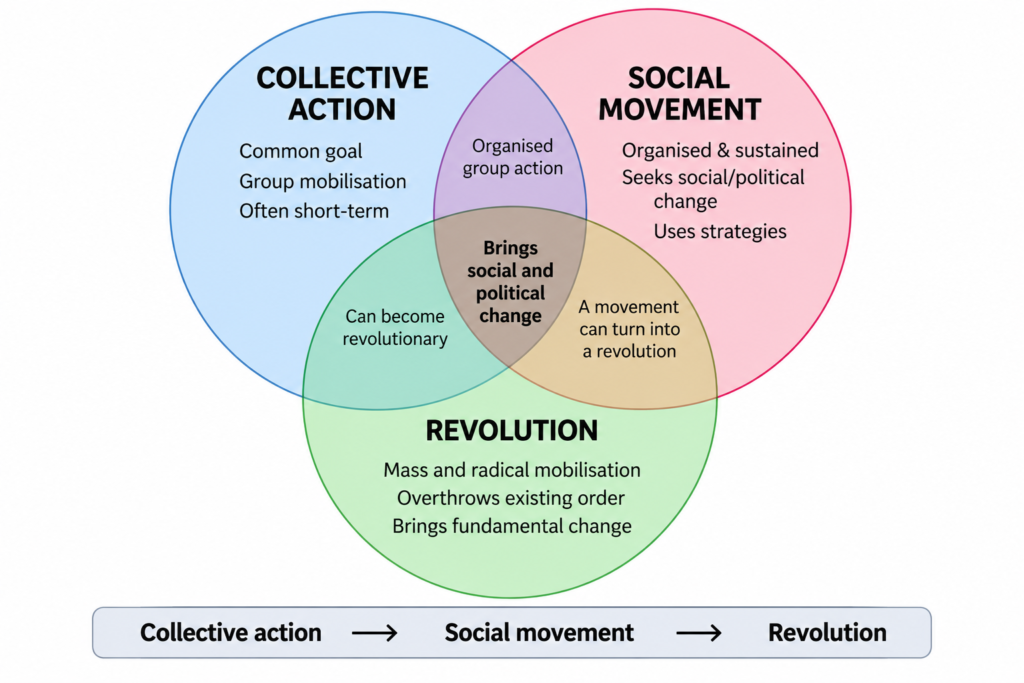
- Collective action becomes foundation of social movements : Collective action brings individuals together around shared grievances or interests.
- Example: Farmers collectively protesting against policies affecting agricultural livelihoods in 2020.
- Social movements to sustained collective action : Unlike spontaneous collective action, social movements involve organisation, leadership, ideology and continuity.
- Charles Tilly views social movements as organised and sustained campaigns making collective claims on authorities.
- Example: India’s Chipko Movement mobilised communities to protect forests.
- Social movements to gradual social change : Movements challenge existing norms, values and institutions and can bring changes without overthrowing the political system.
- Example: The women’s movement contributed to changes in laws, political representation and gender norms.
- Collective action → political change : Mobilisation can influence governments through protests, strikes, campaigns and electoral pressure.
- Example: India’s anti-corruption movement of 2011 generated significant political debate and institutional responses.
- CJP Movement 2026 Led to Reforms in Education sector.
- Social movements can become revolutionary : When grievances deepen, existing institutions lose legitimacy and mobilisation becomes sufficiently broad and radical, a movement may contribute to revolutionary transformation.
- Example: The French Revolution (1789) transformed France’s political and social order.
- Revolution to radical transformation : Karl Marx saw revolutionary collective action as potentially transforming the basic class structure of society.
- Example: The Russian Revolution of 1917 fundamentally altered the political and economic system.
- Not every movement becomes a revolution : Most social movements seek reforms, whereas revolutions seek fundamental structural transformation.
- Example: The Civil Rights Movement in the USA sought equality within the existing political system rather than overthrowing it.
Conclusion
Collective action provides the mobilizational base, social movements provide organisation and continuity, while revolution represents the most radical possibility of collective mobilisation. As Tilly emphasises, collective mobilisation becomes politically significant when groups make sustained claims against existing power structures. Hence, social change exists on a continuum from collective action and reform oriented movements to revolutionary transformation.