


2026
PAPER 1
10 MARKS
In what ways do class and caste intersect and overlap in shaping social structure?
Introduction
Among the various axes of stratification, caste and class remain two of the most debated categories in both sociology and public discourse. Though distinct in origin and structure, caste and class often intersect and reinforce each other in complex ways.
Main Body :
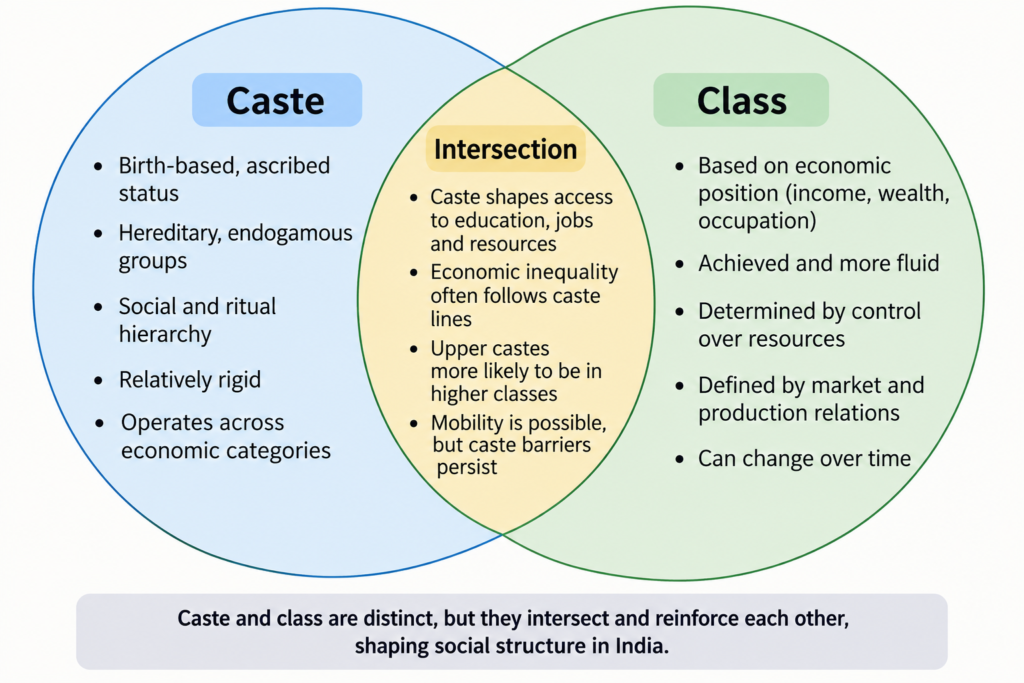
Ways in which class and caste intersect and overlap:
- Economic inequality: Historically disadvantaged castes have had less access to land, education and capital, creating class inequalities.
- B.R. Ambedkar – caste as a system of graded inequality
- Occupation: Caste traditionally determined occupations, influencing income and class position.
- G.S. Ghurye – occupational division of caste
- Education & employment: Higher castes have often enjoyed greater access to quality education and formal-sector jobs.
- Andre Beteille – inequality of caste, class and power
- Land ownership: In rural India, caste hierarchy frequently overlaps with control over land and economic resources.
- M.N. Srinivas’ concept of “dominant caste” shows how numerical strength, land ownership and political power can combine with caste status.
- Social capital: Dominant castes may possess networks and cultural capital that facilitate upward mobility.
- Pierre Bourdieu – social & cultural capital
- Urbanisation: New occupations and education weaken the caste-class overlap, allowing some lower-caste groups to achieve middle-class status.
- Yogendra Singh – modernization of Indian tradition
- Political mobilisation: Caste groups increasingly mobilise around economic interests, reservations and redistribution.
However, Caste and Class Do Not Completely Overlap
- Caste ≠ Class: Andre Beteille argues that caste, class and power are distinct dimensions of stratification; they may overlap but should not be treated as identical.
- Economic mobility without caste mobility: A person from a lower caste can become economically prosperous, yet caste identity may continue to affect marriage and social relations.
- Caste mobility: M.N. Srinivas – Sanskritization shows that social status can change culturally without necessarily changing economic class.
- Class cutting across caste: The emergence of a middle class has created similar consumption patterns and lifestyles across different castes.
- Urbanisation & education: Yogendra Singh highlights modernization as weakening some traditional caste-based structures.
- Caste within the rich: Economic advancement does not automatically eliminate caste-based discrimination, showing that class cannot completely replace caste.
Conclusion
Thus, caste provides a social and cultural hierarchy, while class provides an economic hierarchy. Their intersection produces complex patterns of privilege, deprivation and mobility in Indian society.
Explore More
Sociology Resources