


B : Structural-Functionalism and Structuralism
B.1 BRONISLAW MALINOWSKI
Bronislaw Malinowski, a brilliant Polish scientist turned anthropologist, founded the functionalist school in Britain. This marked a turning point in the history of sociology because under Malinowski’s leadership, functionalism was firmly grounded into the directly observable and scientifically collected information (also referred to as empirical reality) about society and its institutions.
| PRECURSORS OF MALINOWSKI |
18th-Century Moral Philosophers
- Thinkers: David Hume, Adam Smith, Adam Ferguson (Britain); Montesquieu, Condorcet (France).
- Idea: Sought the origins of human institutions and universal laws of society by looking at “primitive” societies.
- Method: Purely deductive armchair philosophy. They collected no empirical evidence, instead basing theories on the prevailing cultural norms of their time.
- Significance: Established human societies as a valid, scientific subject of study, laying the groundwork for modern sociology.
19th-Century Evolutionists
- Thinkers: Charles Darwin (biology), Sir Henry Maine, J.F. McLennan, E.B. Tylor, L.H. Morgan, Sir James Frazer.
- Idea: Inspired by Darwinian evolution, they argued all human societies pass through identical, unilinear stages of development (e.g., promiscuity to patriarchy; magic to religion to science).
- Method: Compiled extensive but haphazard secondary data from missionaries, travelers, and colonial administrators.
- Critique: Heavily criticized by later scholars for being purely conjectural, ethnocentric, and evaluative. Famous armchair anthropologists like Frazer never actually met the people they wrote about.
The Diffusionists
- Idea: Argued that human progress occurred through the transmission (diffusion) of cultural traits from one group to another, rather than independent evolution.
- Extreme Views: Scholars like Elliot Smith and W.J. Perry claimed all human civilization originated from a single source (ancient Egypt) and spread outward—a theory Malinowski heavily criticized.
- Significance: Pioneered ethnology (comparing cultural traits across regions) and mapped the geographical spread of human societies.
The Birth of Social Anthropology (Early 20th Century)
- The Shift: A rejection of speculative historical reconstruction in favor of studying contemporary societies for their own sake.
- Methodology: Introduction of rigorous, first-hand ethnographic fieldwork (participant observation). Anthropologists were now required to live among the people they studied for extended periods.
- The Pioneer: Malinowski’s Argonauts of the Western Pacific (1922), an intensive study of the Trobriand Islanders, became the gold standard for this new scientific approach, effectively launching modern British Social Anthropology.
| CONCERN WITH DATA COLLECTION |
The Shift to Scientific Fieldwork
- The Problem: 19th-century scholars (mostly lawyers and philosophers) relied on unverified, secondary data to reconstruct human history.
- The Solution: 20th-century scholars (mostly trained natural scientists) insisted on testing theories through direct, first-hand observation.
- Practical Drivers: Colonial administrators and missionaries needed accurate socio-cultural data to govern and convert local populations effectively.
Early Milestones
- Franz Boas (1883-84): Conducted fieldwork among Eskimos and American Indians, emphasizing the absolute necessity of learning the local language.
- Torres Straits Expedition (1898-99): Led by A.C. Haddon, this multidisciplinary expedition established professional fieldwork training.
- Solo Expeditions: Scholars like W.H.R. Rivers (Todas of India, 1901) and A.R. Radcliffe-Brown (Andaman Islands, 1906-8) published detailed accounts of specific cultures.
Malinowski’s Revolution
Bronisław Malinowski transformed anthropological data collection into what is now known as participant observation.
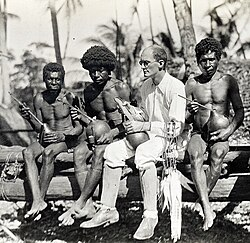
- The Location: He lived in the Trobriand Islands for a total of two years (between 1915 and 1918).
- Total Immersion: He isolated himself from Europeans, pitching his tent directly among the native huts to observe daily life continuously.
- Language Mastery: He discarded pidgin-English and interpreters, mastering the native dialect within three months.
- Theoretical Impact: He didn’t just passively collect facts; he developed specific fieldwork techniques to uncover the underlying principles of societal organization, leading directly to his theory of functionalism.
| CULTURE AS A FUNCTIONING AND INTEGRATED WHOLE |
Meaning of Culture
- Malinowski viewed culture as a functioning whole consisting of interconnected parts.
- Culture is a “vast apparatus” through which humans deal with concrete problems of life.
- It includes both material and non-material elements.
- Culture is learned, shared and transmitted between individuals.
Components of Culture
Malinowski identified three broad components:
| Component | Includes |
| Material culture | Implements, tools, consumer goods, physical artefacts |
| Human activities/customs | Customs, practices and social organisation |
| Social & ideological elements | Social institutions, beliefs, ideas, values and traditions |
Culture is almost everything connected with human life and action.
Malinowski vs Tylor
- Tylor: Culture is a “complex whole” including knowledge, belief, art, law, morals, customs, etc.
- Malinowski: Culture comprises inherited artefacts, goods, technical processes, ideas, habits and values.
Main difference
- Tylor → Complexity of culture
- Malinowski → Wholeness and functioning of culture
Malinowski went beyond merely listing cultural elements and asked: What function does each cultural element perform?
Functionalist Approach
- Culture should be studied as an integrated and functioning whole.
- Every custom, belief or institution has a function/use within the cultural system.
- Cultural practices help in maintaining the continuity of the whole culture.
- Culture should be studied “in its own right” and as a self-contained reality.
- Malinowski opposed approaches that explained cultures mainly through:
- Evolutionism → placing cultures on an evolutionary scale.
- Diffusionism → explaining cultures through geographical spread.
Fieldwork Method
Malinowski is associated with the development of intensive fieldwork/participant observation in anthropology.
Three types of data
1. Statistical documentation
- Concrete evidence about institutions and customs.
- Collect people’s descriptions and observe actual cases.
2. Observation of everyday behaviour
- Observe what people actually do.
- Maintain an ethnographic diary.
- Record exceptions and variations from formal rules.
3. Ethnographic statements
- Collect:
- Narratives
- Folklore
- Typical statements
- Magical formulae
- Helps understand native mentality/thought.
Important distinction
| What people say | What people do | What people think |
| Statements/descriptions | Actual behaviour | Beliefs, narratives, mentality |
A good fieldworker must understand the gap between these three.
Function and Human Needs
- Malinowski understood function as use.
- Cultural institutions and practices exist because they help satisfy human needs.
- Therefore, his functionalism has a strong connection with psychology.
- Different cultural elements are interconnected because they contribute to the functioning of the cultural whole.
| Criticism of Malinowski |
Kuper’s criticism:
- Malinowski emphasised relationships between different cultural elements but allegedly lacked a clear notion of the system.
- He described individual parts and their connections but did not fully explain the underlying structure/essence of the cultural system.
Example
Describing how arms → shoulders → neck are connected does not by itself constitute a complete theory of anatomy.
| Theory of Needs |
Meaning
- Malinowski explained culture and social facts through his Theory of Needs.
- Developed mainly in A Scientific Theory of Culture (1944).
- Need = conditions necessary for the survival of the individual and the group.
- Culture develops mechanisms to satisfy human needs.
- Needs are related to both individual survival and social survival.
Biological Impulses
Malinowski identified basic biological impulses and their cultural/physical satisfaction:
| Impulse | Act | Satisfaction |
| Breathing | Intake of oxygen | Elimination of CO₂ |
| Hunger | Eating | Satiation |
| Thirst | Drinking | Quenching |
| Sex | Sexual activity | Satisfaction |
| Fatigue | Rest | Restoration of energy |
| Somnolence | Sleep | Awakening/restored energy |
| Bladder pressure | Urination | Removal of tension |
| Colon pressure | Defecation | Abdominal relaxation |
| Fright | Escape | Relaxation |
| Pain | Avoidance | Return to normal state |
Three Types of Needs
A. Basic Needs — Primary Determinism
These are essential for individual and group survival.
| Basic Need | Cultural Response |
| Metabolism | Commissariat / food supply |
| Reproduction | Kinship |
| Bodily comforts | Shelter |
| Safety | Protection |
| Movement | Activities |
| Growth | Training |
| Health | Hygiene |
Biological needs → Cultural responses.
B. Derived Needs — Secondary Determinism
When humans live in society, satisfying basic needs creates additional social/cultural requirements.
| Derived Need | Cultural Response |
| Maintenance of cultural apparatus | Economics |
| Regulation of behaviour | Social control |
| Socialisation | Education |
| Exercise of authority | Political organisation |
Basic needs → Social life → Derived needs
Culture therefore creates mechanisms for maintaining and organising society.
C. Integrative Needs — Integrative Imperatives
These provide unity, continuity and meaning to social life.
They include:
- Tradition
- Norms
- Values
- Religion
- Art
- Language
- Symbolism
Important transformation:
- Habit → Custom
- Child care → Training of next generatio
- Impulse → Values
Malinowski therefore considered symbolism and values central to human culture.
| Primary vs Secondary Determinism |
Primary Determinism
- Biological needs → Cultural responses
- Example: Hunger → Food production/economic arrangements
Secondary Determinism
- Social life → Additional cultural requirements
- Example: Need for social order → Social control
Malinowski did not argue that culture simply satisfies biological impulses.
Culture also regulates and limits biological impulses.
Thus: Biological impulse → Cultural regulation → Socially acceptable behaviour
Example: Sexual impulse is regulated through kinship, marriage and social norms.
Importance of Theory of Needs
- Provides a link between biology and culture.
- Explains why cultural institutions exist.
- Helps compare different societies.
- Provides an empirical framework for fieldwork.
- Connects social structure and cultural institutions with human needs.
- Shows that different institutions perform different functions.
BRONISLAW MALINOWSKI
GATE Sociology • UGC NET Sociology • UPSC Sociology Optional
Download the complete Sociologus notes on Bronislaw Malinowski. These concise sociology notes cover his concept of culture, functionalism, theory of needs, participant observation, fieldwork methodology, biological impulses, basic and derived needs, integrative imperatives, and his study of magic in Trobriand society.
Free Sociology Study Material by Sociologus.com
Bronislaw Malinowski Sociology Notes PDF
Download Bronislaw Malinowski Sociology Notes PDF for GATE Sociology, GATE XH C6 Sociology, UGC NET Sociology and UPSC Sociology Optional. These notes cover Malinowski’s functionalism, concept of culture, theory of needs, basic needs, derived needs, integrative imperatives, fieldwork, participant observation and the social function of magic.
These Malinowski notes are designed for quick revision, conceptual understanding and sociology examination preparation.
| PYQs CONNECT |
GATE XH C6 2024 Q : Select the option that has the correct pairing of author and concept.
| Author | Concept |
| L : Bronislaw Malinowski | Q ; Sociological imagination |
| M : Erving Goffman | R : Imponderabilia of everyday life |
| N : Claude Levi-Strauss | S : Matrimonial strategies |
| O : Pierre Bourdieu | T : Generalized exchange |
| U : Social performance |
EXPLANATION : Bronislaw Malinowski famously coined the term “imponderabilia of everyday life” to describe the subtle, routine, and mundane aspects of daily behavior that an ethnographer must capture through participant observation (matching R).
| Malinowski’s Essay on Baloma Malinowski studied the Trobriand Islanders through fieldwork. He lived among the people of Omarakana and Kiriwina and learned their local language. This helped him understand their culture closely.Malinowski found that magic was an important part of everyday life. People used magical practices in many activities, especially gardening and agriculture.The garden magician (towosi) had an important role in agricultural activities. People believed that his magical practices helped in the success of their gardens.The magician collected different herbs and plants from places such as the seashore, woodland and scrub areas. He collected them before sunrise.After collecting the herbs, the magician placed them on mats and chanted magical spells over them. These herbs were then used in garden ceremonies.Malinowski observed that the community highly valued the garden magician. Agricultural work was difficult to imagine without his cooperation. |
| To get Monthly Magazine Join Telegram Telegram link : Click here Visit Website : www.sociologus.com |
Trobriand Islands | Omarakana | Kiriwina | Kiriwinian | Participant observation | Towosi | Garden magic | Magical spells | Herbs | Agriculture | Function of magic | Functionalism | Cultural context | Theory of Needs | Biological impulses | Primary determinism | Secondary determinism | Basic needs | Derived needs | Integrative imperatives | Cultural responses | Human needs | Social control | Socialisation | Symbolism | Values | Functionalism | Institution | Biology–culture relationship | Culture as functioning whole | Integrated whole | Function/use | Human needs | Participant observation | Ethnographic diary | Statistical documentation | Native mentality | Self-contained reality | Functionalism | Tylor vs Malinowski | Evolutionism | Diffusionism | Kuper’s criticism
GATE Sociology Notes, GATE Sociology Study Material, GATE Sociology Preparation, GATE XH C6 Sociology, GATE Sociology Notes PDF, GATE Sociology Previous Year Questions, GATE Sociology PYQs, GATE Sociology Solved Papers, UGC NET Sociology Notes, UGC NET Sociology Study Material, UGC NET Sociology Preparation, UGC NET Sociology Notes PDF, UGC NET Sociology PYQs, UPSC Sociology Notes, UPSC Sociology Optional Notes, UPSC Sociology Study Material, UPSC Sociology Preparation, UPSC Sociology Notes PDF, UPSC Sociology PYQs, UPSC Sociology Optional, Sociology Notes, Sociology Study Material, Sociology Revision Notes, Sociology Short Notes, Sociology Exam Preparation