

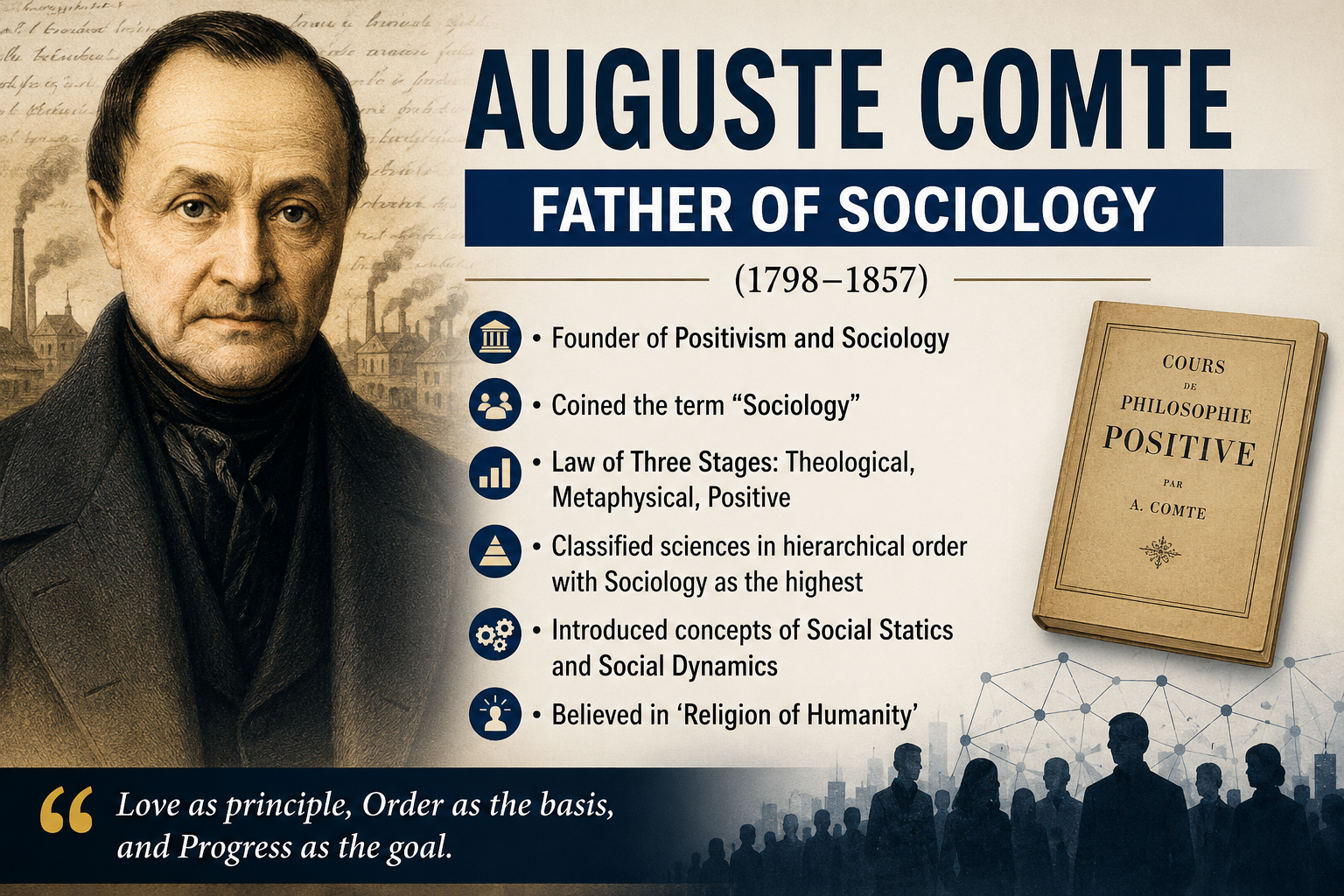

Auguste Comte is universally recognized as the Father of Sociology because he was the first thinker to systematically establish sociology as a distinct scientific discipline. Living during a period marked by the French Revolution, the Napoleonic Wars, and the Industrial Revolution, Comte witnessed immense political, economic, and social upheaval. Traditional institutions such as the Church and monarchy were losing their authority, while industrialization was rapidly transforming social relations. In this context of uncertainty and disorder, Comte believed that society required a new science that could understand social phenomena scientifically and provide solutions for restoring social order. He coined the term “Sociology” in 1838 and envisioned it as the highest and most comprehensive science capable of studying human society through objective methods.
Auguste Comte (1798–1857) is widely regarded as the Father of Sociology and the founder of Positivism. He was the first thinker to use the term “Sociology” and sought to establish it as a scientific discipline capable of understanding and improving society. Living during a period of profound social and political upheaval in Europe, Comte witnessed the aftermath of the French Revolution, the Napoleonic Wars, and the rapid changes brought about by the Industrial Revolution. These transformations convinced him that society required a new scientific approach to understand social order and social change.
A central aspect of Comte’s thought was his doctrine of Positivism. Positivism emphasized that genuine knowledge must be based on observation, experimentation, comparison, and empirical evidence rather than speculation, theology, or metaphysical reasoning. Influenced by the success of natural sciences such as physics, chemistry, and biology, Comte argued that society too operates according to discoverable laws. Just as scientists identify laws governing the physical world, sociologists should identify laws governing social life. He believed that scientific knowledge alone could provide certainty and progress, replacing the confusion created by religious dogma and philosophical speculation. Through positivism, Comte sought to transform the study of society from a field of abstract reflection into a rigorous science capable of guiding social reform.
One of Comte’s most influential contributions is the Law of Three Stages, which explains the intellectual evolution of humanity. According to Comte, human thought develops through three successive stages: the theological stage, the metaphysical stage, and the positive stage. In the theological stage, people explain natural and social phenomena through supernatural forces, gods, and divine intervention. In the metaphysical stage, supernatural explanations are replaced by abstract concepts such as nature, reason, and essence. Finally, in the positive stage, individuals rely on scientific observation and empirical investigation to understand reality. Comte considered the positive stage the highest level of intellectual development because it is based on verifiable facts and scientific reasoning. He argued that modern societies were gradually entering this scientific stage, making sociology both possible and necessary.
Comte also developed a hierarchy of sciences to demonstrate the place of sociology within human knowledge. He arranged sciences in ascending order of complexity: Mathematics, Astronomy, Physics, Chemistry, Biology, and Sociology. According to him, each science depends upon the knowledge developed by the sciences preceding it. Sociology occupies the highest position because society is the most complex phenomenon to study. Human behaviour is influenced by biological, psychological, cultural, economic, and political factors, making sociology the most comprehensive science. For this reason, Comte described sociology as the “Queen of Sciences,” capable of synthesizing knowledge from all other disciplines and applying it to social improvement.
Another major contribution of Comte was his distinction between Social Statics and Social Dynamics. Social Statics refers to the study of social order, stability, and the institutions that maintain social cohesion, such as family, religion, and government. Comte believed that understanding these institutions was essential for preserving harmony within society. Social Dynamics, on the other hand, focuses on social change and progress. It examines the forces that drive historical development and societal transformation. Through these concepts, Comte attempted to explain both continuity and change within society, laying the foundation for later sociological theories concerning social structure and social evolution.
Comte’s intellectual influence extended far beyond his own lifetime. His emphasis on scientific methods inspired later sociologists such as Émile Durkheim, Herbert Spencer, and Harriet Martineau. Although some of his ideas, particularly his belief in an intellectual elite guiding society, have been criticized as overly authoritarian, his broader vision of sociology as a scientific study of society remains influential. Modern sociological research continues to employ observation, classification, comparison, and empirical analysis—principles strongly rooted in Comte’s positivist philosophy. Consequently, Auguste Comte occupies a foundational place in sociological thought, and his contributions continue to shape the discipline’s theoretical and methodological orientation.
Key Works of Auguste Comte
- Course of Positive Philosophy (1830–1842)
- System of Positive Polity (1851–1854)
- A General View of Positivism (1848)
Famous Quote
“Love as principle, Order as the basis, and Progress as the go
Comte believed that just as natural sciences such as physics and chemistry discovered laws governing the physical world, sociology could discover laws governing human society. His ideas laid the intellectual foundation for modern sociology and influenced later sociologists such as Émile Durkheim, Herbert Spencer, and many others.
Historical Background
Auguste Comte lived during a time when traditional institutions such as the Church and monarchy were losing their authority. The French Revolution had challenged old social structures, while industrialization was creating new forms of social organization. Society appeared unstable and uncertain.
Comte believed that Europe was passing through a critical stage in human history. People had lost faith in traditional beliefs, yet no new system of thought had emerged to guide society. To solve this problem, he proposed a scientific study of society that could provide order, stability, and progress.
Law of Three Stages
One of Comte’s most famous theories is the Law of Three Stages, which explains the intellectual evolution of human society.
1. Theological Stage
In this stage, people explain events through supernatural or divine powers.
Characteristics:
- Dominance of religion and faith.
- Natural events attributed to gods or spirits.
- Social order maintained through religious authority.
Example:
Ancient societies believed that floods, droughts, and diseases were caused by divine intervention.
2. Metaphysical Stage
This is a transitional stage between theology and science.
Characteristics:
- Abstract concepts replace supernatural explanations.
- Philosophical reasoning becomes important.
- People seek explanations through ideas such as nature, essence, or destiny.
Example:
Instead of gods causing events, people explain them through abstract forces or natural rights.
3. Positive (Scientific) Stage
This is the highest stage of intellectual development.
Characteristics:
- Knowledge based on observation and scientific methods.
- Search for laws governing natural and social phenomena.
- Rejection of supernatural and metaphysical explanations.
Example:
Modern scientists explain diseases through biological causes rather than divine punishment.
According to Comte the Father of Sociology , humanity had entered the Positive Stage, where science would become the dominant source of knowledge.
Hierarchy of Sciences
Comte developed a classification of sciences based on their complexity and historical development.
He arranged them in the following order:
- Mathematics
- Astronomy
- Physics
- Chemistry
- Biology
- Sociology
According to Comte:
- Simpler sciences develop first.
- More complex sciences depend upon simpler sciences.
- Sociology is the most complex science because it studies human society.
- Sociology represents the highest achievement of scientific knowledge.
This classification demonstrated Comte’s belief that sociology deserved recognition as a scientific discipline.
Social Statics and Social Dynamics
Comte the Father of Sociology divided sociology into two major branches:
Social Statics
Social statics studies the forces that maintain social order and stability.
It focuses on:
- Family
- Religion
- Government
- Social institutions
- Social cohesion
Comte believed that these institutions help maintain harmony and stability in society.
Social Dynamics
Social dynamics studies social change and social progress.
It focuses on:
- Social evolution
- Historical development
- Transformation of institutions
- Progress of human society
According to Comte, societies are constantly evolving, and social dynamics helps explain how and why this change occurs.
Sociology as the Queen of Sciences
Comte the Father of Sociology famously described sociology as the “Queen of Sciences.”
He believed sociology occupied the highest position among all sciences because:
- It studies the most complex phenomenon—human society.
- It synthesizes knowledge from all other sciences.
- It provides guidance for social reform and social planning.
For Comte, sociology was not merely an academic discipline; it was a practical science capable of solving social problems.
Religion of Humanity
In his later years, Comte developed the concept of the Religion of Humanity.
Key Features:
- Humanity becomes the object of reverence.
- Moral guidance replaces traditional theology.
- Sociologists act as moral and intellectual leaders.
- Social unity becomes the ultimate goal.
Although this idea received criticism, it reflected Comte’s desire to create social cohesion in an increasingly secular world.
Influence on Sociology
Auguste Comte’s ideas had a profound impact on the development of sociology.
His influence can be seen in the works of:
- Émile Durkheim
- Herbert Spencer
- John Stuart Mill
- Harriet Martineau
- Lester Ward
His emphasis on scientific methods encouraged sociologists to study society systematically and objectively.
Many modern sociological research methods, including observation and empirical investigation, reflect Comte’s positivist approach.
Criticisms of Auguste Comte
Despite his contributions, Comte’s theories have been criticized.
1. Overemphasis on Science
Critics argue that not all aspects of human behaviour can be understood through scientific methods alone.
2. Deterministic View of Progress
His Law of Three Stages assumes all societies follow the same path of development, which many sociologists reject.
3. Neglect of Conflict
Comte emphasized order and stability while paying little attention to social conflict and inequality.
4. Elitist Vision
His idea that intellectual experts should guide society has been criticized as undemocratic.
Nevertheless, these criticisms do not diminish his foundational role in sociology.
Conclusion
Auguste Comte the Father of Sociology remains one of the most influential thinkers in the history of sociology. As the founder of sociology and the creator of positivism, he sought to apply scientific methods to the study of society. His concepts of the Law of Three Stages, Social Statics, Social Dynamics, and the Hierarchy of Sciences established the intellectual foundations of sociological thought.
Although some of his ideas have been challenged, Comte’s vision of sociology as a scientific discipline continues to shape sociological research and theory today. His work transformed the study of society from philosophical speculation into a systematic and scientific enterprise, earning him the enduring title of the Father of Sociology.