

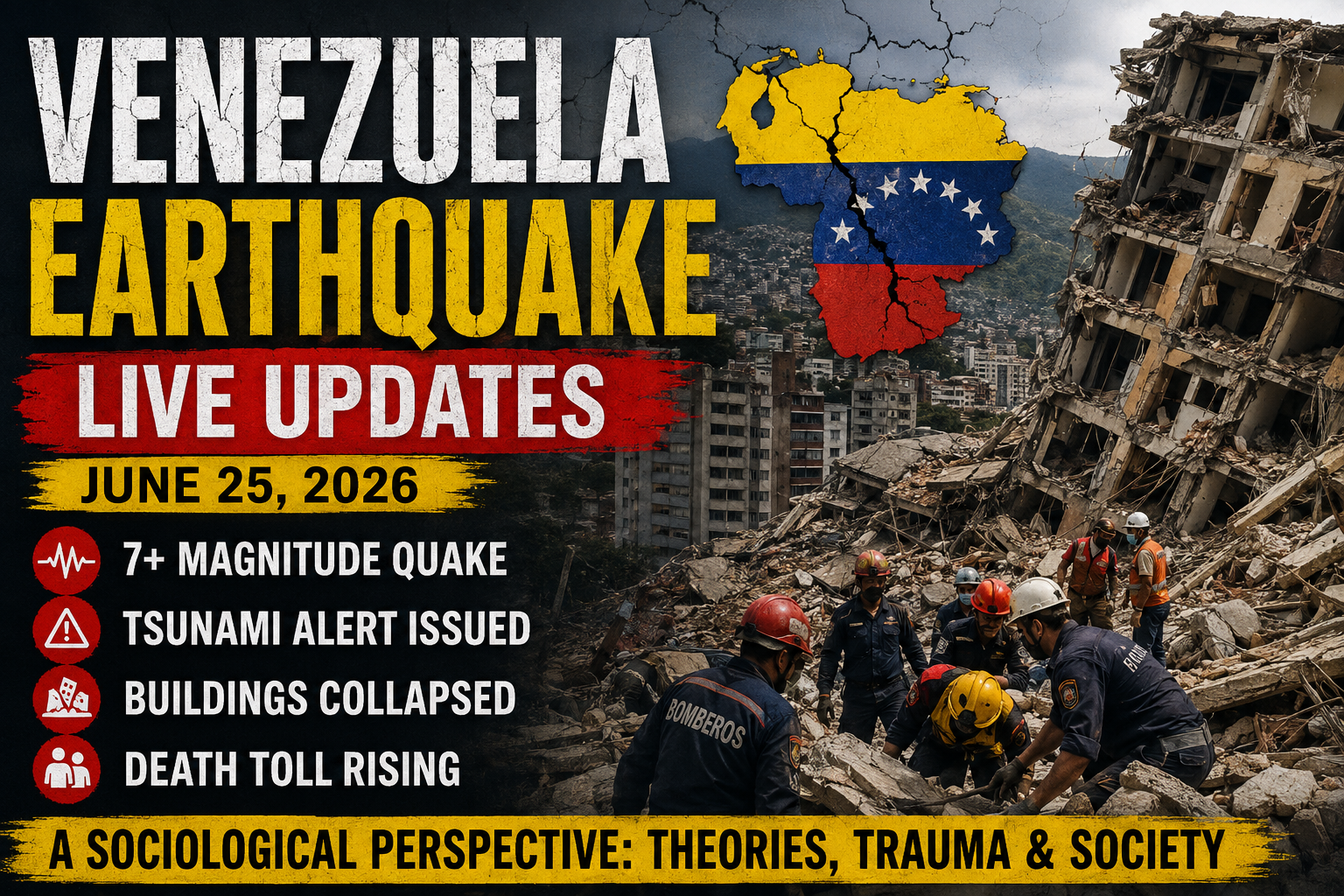

The devastating Venezuela earthquake of June 2026 has emerged not only as a geological catastrophe but also as a profound social event. According to recent reports, two powerful earthquakes measuring approximately 7.2 and 7.5 magnitude struck northern Venezuela within seconds of each other, causing extensive destruction in Caracas, La Guaira, and surrounding regions. Hundreds of people have been killed, thousands injured, and many more displaced as rescue operations continue amid fears of aftershocks and infrastructure collapse. The Venezuela earthquake has become one of the most destructive disasters in the country’s recent history and has generated worldwide humanitarian concern.
From a sociological perspective, the Venezuela earthquake is not merely a natural disaster. Sociology argues that while earthquakes may be natural phenomena, their consequences are deeply shaped by social structures, inequalities, institutions, and collective responses. Therefore, understanding the Venezuela earthquake requires an examination of social vulnerability, collective trauma, social solidarity, state capacity, and the role of global humanitarian networks.
The Functionalist perspective, particularly associated with Émile Durkheim, provides one way of understanding the Venezuela earthquake. Durkheim argued that crises often reveal the hidden bonds that hold societies together. Following the Venezuela earthquake, rescue workers, volunteers, community groups, and ordinary citizens mobilized to save lives and provide relief. Families opened their homes to displaced persons, while international agencies and neighboring countries offered assistance. Such responses demonstrate what Durkheim described as social solidarity. In moments of crisis, individuals often transcend personal interests and act collectively for the common good. The Venezuela earthquake therefore illustrates how disasters can strengthen social cohesion and reinforce collective consciousness.
At the same time, Robert K. Merton’s concept of dysfunction helps explain the negative consequences generated by the Venezuela earthquake. Critical infrastructure, including transportation networks, housing, communication systems, and healthcare facilities, suffered severe disruption. These dysfunctions affect not only immediate survival but also long-term social stability. Schools may remain closed, employment opportunities decline, and communities experience prolonged uncertainty. Thus, the Venezuela earthquake highlights how social systems can become temporarily disorganized when major institutions fail to perform their expected functions.
Are u UPSC aspirant? Is your Optional Sociology? Visit The free notes page
Conflict theory, associated with Karl Marx and later critical sociologists, offers a different interpretation of the Venezuela earthquake. Conflict theorists argue that disasters do not affect all social groups equally. The impact of the Venezuela earthquake is likely to be disproportionately borne by poorer communities living in vulnerable housing and underserved neighborhoods. Wealthier citizens often possess greater resources, safer buildings, insurance coverage, and access to private healthcare. In contrast, marginalized populations face greater risks of injury, displacement, and economic hardship. The Venezuela earthquake therefore exposes pre-existing social inequalities that existed long before the disaster occurred. Disasters often reveal structural inequalities rather than creating them.
Contemporary disaster sociologists such as Kai Erikson have emphasized the concept of collective trauma. Unlike individual trauma, collective trauma affects entire communities and reshapes social relationships. The Venezuela earthquake has generated widespread fear, grief, uncertainty, and psychological distress. Survivors have witnessed collapsed buildings, loss of loved ones, destruction of homes, and uncertainty about the future. These experiences create lasting emotional scars that extend beyond physical reconstruction. Communities affected by the Venezuela earthquake may continue to experience anxiety, depression, and social dislocation for years after the event.
The concept of the “risk society,” developed by Ulrich Beck, is particularly relevant to understanding the Venezuela earthquake. Beck argued that modern societies increasingly confront large-scale risks whose consequences extend beyond individual control. Although earthquakes originate from natural geological processes, their social impacts are shaped by urbanization, infrastructure planning, governance, and preparedness. The Venezuela earthquake demonstrates how contemporary societies remain vulnerable despite technological advancement. Modern cities concentrate large populations, making seismic events capable of producing massive social disruption. The earthquake therefore reflects the broader challenges of managing risk in an increasingly interconnected world.
From the perspective of symbolic interactionism, represented by thinkers such as George Herbert Mead and Herbert Blumer, the social meaning attached to the Venezuela earthquake is equally important. Media coverage, survivor narratives, government statements, and public discourse shape how people interpret the disaster. Images of collapsed buildings, rescue efforts, and grieving families become powerful symbols that influence collective understanding. Through social media and news reporting, the Venezuela earthquake has become a shared global event, generating empathy and international solidarity far beyond Venezuela’s borders.
The Venezuela earthquake also highlights the sociological importance of social capital, a concept associated with Pierre Bourdieu, James Coleman, and Robert Putnam. Communities with strong networks of trust and cooperation are often better equipped to respond to disasters. Neighbors sharing resources, volunteers organizing relief efforts, and local associations coordinating rescue operations all represent forms of social capital. In many disaster situations, these informal networks can be as important as formal government interventions. The effectiveness of local community responses following the Venezuela earthquake demonstrates the value of social relationships in times of crisis.
Another important sociological dimension is the role of the state. Max Weber defined the modern state as an institution possessing legitimate authority and administrative capacity. During disasters such as the Venezuela earthquake, citizens expect governments to provide security, relief, reconstruction, and coordination. The effectiveness of governmental response significantly shapes public trust and legitimacy. Delays in aid distribution, communication failures, or inadequate preparedness can undermine confidence in public institutions, whereas efficient disaster management can strengthen state legitimacy. Thus, the Venezuela earthquake serves as a crucial test of institutional capacity and governance.
Historically, Venezuela has experienced devastating earthquakes, including the 1812 Caracas earthquake and the 1967 Caracas earthquake. These historical experiences demonstrate that natural hazards repeatedly influence patterns of urban planning, public policy, and collective memory. The 2026 Venezuela earthquake is likely to become another significant reference point in the nation’s social history, shaping future debates on disaster preparedness, building regulations, and urban resilience.
In conclusion, the Venezuela earthquake is far more than a seismic event. It is a sociological phenomenon that reveals the complex interaction between nature and society. Through the lenses of Durkheim’s solidarity, Marx’s conflict theory, Erikson’s collective trauma, Beck’s risk society, Weber’s state authority, and symbolic interactionist perspectives, the Venezuela earthquake illustrates how disasters expose inequalities, reshape social relationships, generate collective trauma, and test institutional capacities. As Venezuela moves from emergency response to long-term recovery, the earthquake will continue to influence social structures, community identities, and public policy. Ultimately, the Venezuela earthquake reminds us that while natural hazards may be unavoidable, their social consequences are profoundly shaped by the organization, resilience, and inequalities of human societies.