


Special Intensive Revision (SIR): Strengthening Electoral Integrity or Pathway to Exclusion?
🌐 Join Our Community
 Telegram Community
 WhatsApp Community
 YouTube Channel
 Instagram
 X (Twitter)
The right to vote is one of the most fundamental democratic rights guaranteed to every eligible citizen of India. While the Constitution does not explicitly classify voting as a Fundamental Right, it is a statutory right under the Representation of the People Act, 1950, and serves as the foundation upon which representative democracy rests. Consequently, the accuracy, inclusiveness, and credibility of electoral rolls are indispensable for ensuring free and fair elections.
Against this backdrop, the Special Intensive Revision (SIR) of Electoral Rolls (2025–2026) has emerged as one of the most debated electoral exercises in recent years. Conceived by the Election Commission of India (ECI) as a mechanism to identify duplicate, deceased, migrated, or ineligible voters and ensure cleaner electoral rolls, the process has also generated widespread controversy.

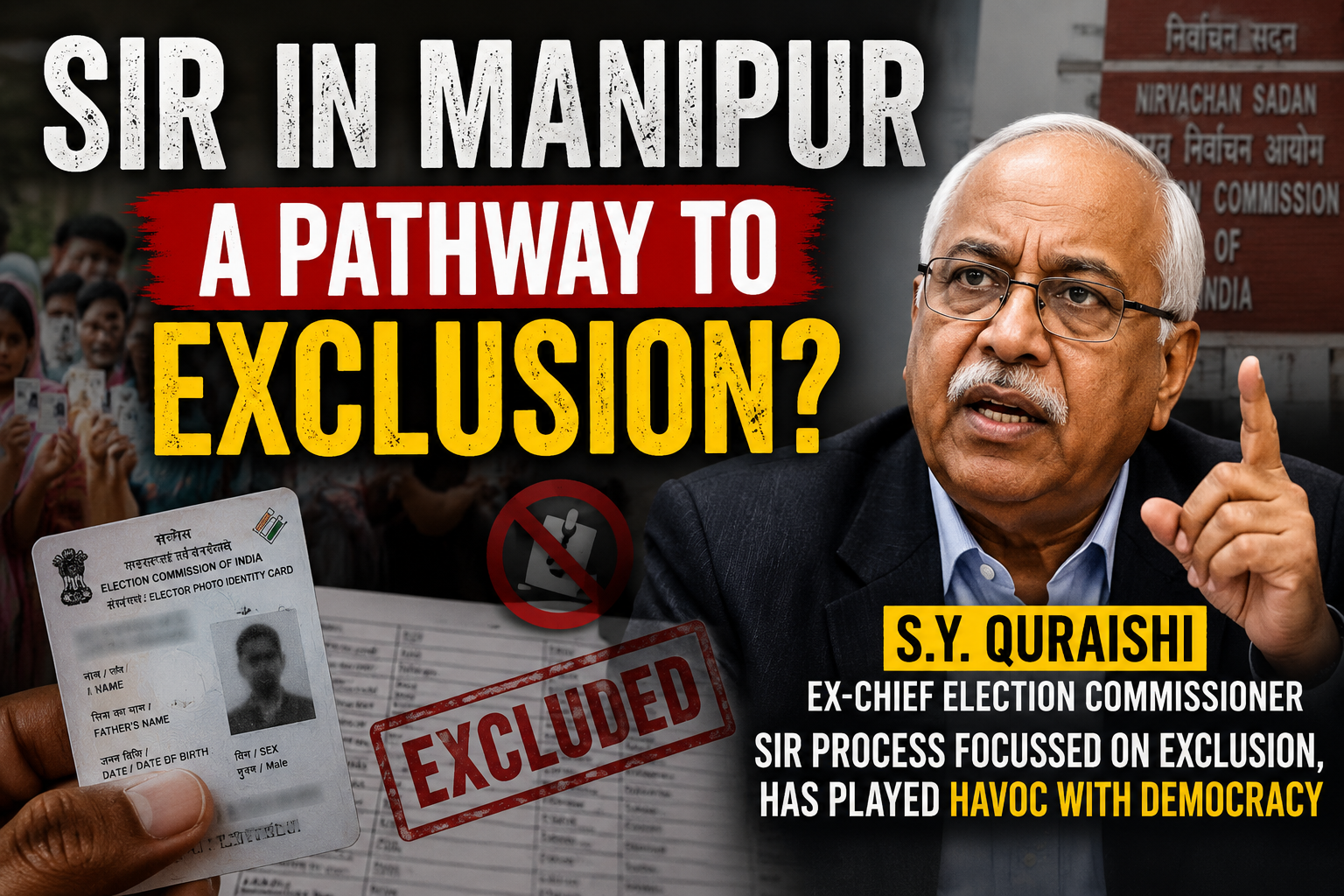
Former Chief Election Commissioner S.Y. Quraishi has argued that the current SIR process is excessively focused on exclusion rather than inclusion, warning that it risks undermining democratic participation. Civil society organisations have similarly expressed concerns that stringent documentation requirements may disproportionately affect economically weaker sections, migrants, tribal communities, women, internally displaced persons, and other vulnerable groups. The Hindu reports
The debate surrounding SIR therefore raises a fundamental constitutional question:
Can the pursuit of electoral purity justify the exclusion of genuine voters?
What is the Special Intensive Revision (SIR)?
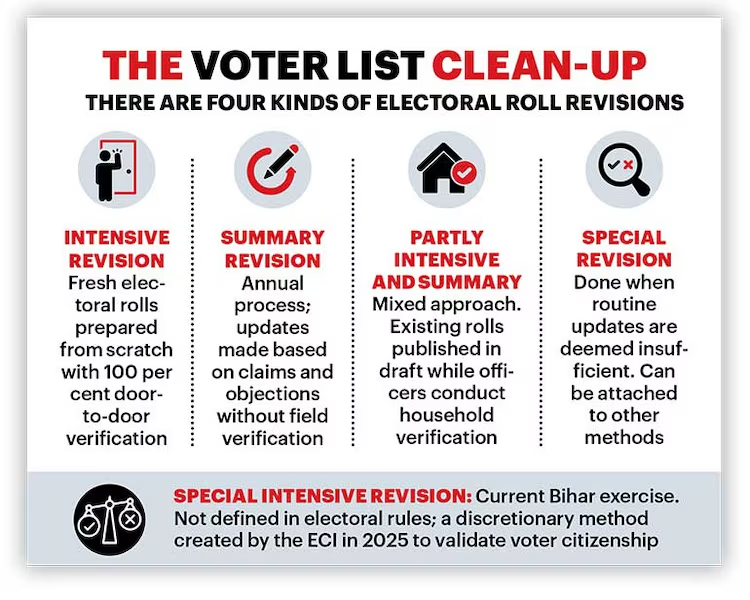
The Special Intensive Revision (SIR) is an extensive verification exercise undertaken by the Election Commission of India (ECI) to comprehensively update electoral rolls.
Unlike the routine annual revision, SIR involves door-to-door verification and detailed scrutiny of voter records to ensure that only eligible citizens remain enrolled.
The exercise generally seeks to:
- Verify the identity of existing electors.
- Remove duplicate entries.
- Delete names of deceased voters.
- Eliminate migrated or permanently shifted voters.
- Prevent enrolment of ineligible persons.
- Improve the overall accuracy of electoral rolls.
Under SIR, Booth Level Officers (BLOs) visit households, verify documents, update demographic details, and collect fresh information wherever necessary. The Election Commission argues that maintaining accurate electoral rolls is essential for preserving electoral integrity and public confidence in elections.
Historical Evolution of Electoral Roll Revision
Electoral roll revision has always been an integral feature of India’s electoral management system.
Early Years (1950–1960)
After independence, India prepared its first electoral roll for the 1951–52 General Elections, one of the largest democratic exercises in world history. The process was primarily manual and relied heavily on local verification.
Periodic Revision
Over the decades, the Election Commission institutionalised:
- Annual Summary Revision
- Continuous Updation
- Special Revision before major elections
These revisions focused mainly on:
- Addition of new voters
- Deletion of deceased persons
- Correction of errors
without requiring extensive re-verification of all electors.
Special Intensive Revision
Whenever the Commission suspected large-scale inaccuracies in electoral rolls, it occasionally conducted Special Intensive Revisions, involving physical verification of every household.
Earlier SIR exercises were generally limited to selected states and exceptional circumstances.
Electoral Roll Revision in 2025–26
The 2025–26 SIR represents one of the most comprehensive voter verification exercises undertaken in recent years.
The Election Commission justified the revision on the grounds of:
- increasing migration,
- duplicate voter registrations,
- technological improvements in verification,
- need for updated demographic information,
- maintaining free and fair elections.
However, unlike earlier revisions, critics argue that the present exercise has imposed greater documentary burdens on electors.
Constitutional and Legal Basis
The authority of the Election Commission to conduct electoral roll revision arises from multiple constitutional and statutory provisions.
Article 324
Article 324 of the Constitution vests the Election Commission with the superintendence, direction and control of elections.
This includes preparation and revision of electoral rolls.
Article 326
Article 326 provides for universal adult suffrage, granting every citizen aged eighteen years or above the right to vote, subject only to constitutional and statutory disqualifications.
Representation of the People Act, 1950
The Act empowers electoral authorities to:
- prepare electoral rolls,
- revise rolls,
- include eligible electors,
- delete ineligible names,
- correct mistakes.
Registration of Electors Rules, 1960
These rules prescribe detailed procedures regarding:
- enrolment,
- objections,
- corrections,
- revisions,
- appeals.
Constitutional Validity Upheld in 2026
Several petitions challenging the legality of the Special Intensive Revision reached constitutional courts.
In 2026, the judiciary broadly upheld the Election Commission’s authority to undertake electoral roll revision under Article 324 and the Representation of the People Act.
However, the courts also reiterated that:
- procedural fairness must be maintained;
- no eligible citizen should be arbitrarily removed;
- principles of natural justice must be followed;
- adequate opportunity should be provided before deletion;
- administrative convenience cannot override constitutional rights.
Thus, while the power to conduct SIR has been upheld, its implementation remains subject to constitutional safeguards.
Why has the SIR become controversial?
Although electoral roll purification is widely accepted as a legitimate objective, several implementation-related concerns have emerged.
1. Documentation Burden
Many electors have reportedly been asked to produce:
- birth certificates,
- legacy documents,
- parental records,
- old electoral records,
- residence proofs.
Large sections of India’s population—particularly rural citizens—often lack such documents.
For many elderly persons, obtaining decades-old records is nearly impossible.
2. Risk of Exclusion
The greatest criticism concerns the possibility that genuine voters may lose voting rights simply because they cannot produce documentary evidence.
Groups considered particularly vulnerable include:
- migrant workers,
- internally displaced persons,
- tribal communities,
- women changing residence after marriage,
- homeless persons,
- elderly citizens,
- economically weaker sections.
Critics argue that procedural exclusion may effectively amount to disenfranchisement.
3. Administrative Capacity
The SIR places enormous responsibility upon:
- Booth Level Officers (BLOs),
- Electoral Registration Officers,
- local administration.
Given limited manpower and tight timelines, concerns have been raised regarding:
- hurried verification,
- inconsistent practices,
- human errors,
- uneven implementation.
4. Psychological Distress
Reports from civil society organisations suggest that fear of losing voting rights has generated significant anxiety among many citizens.
Booth Level Officers themselves have reportedly experienced considerable workload and administrative pressure.
5. Misuse of Objection Procedures
Critics have pointed to possible misuse of objection mechanisms, especially Form 7, which allows objections regarding inclusion of names in electoral rolls.
Mass objections, if improperly handled, may increase the risk of wrongful deletions.
6. Impact on Conflict Areas
In states experiencing:
- ethnic conflict,
- displacement,
- migration,
- natural disasters,
document verification becomes substantially more difficult.
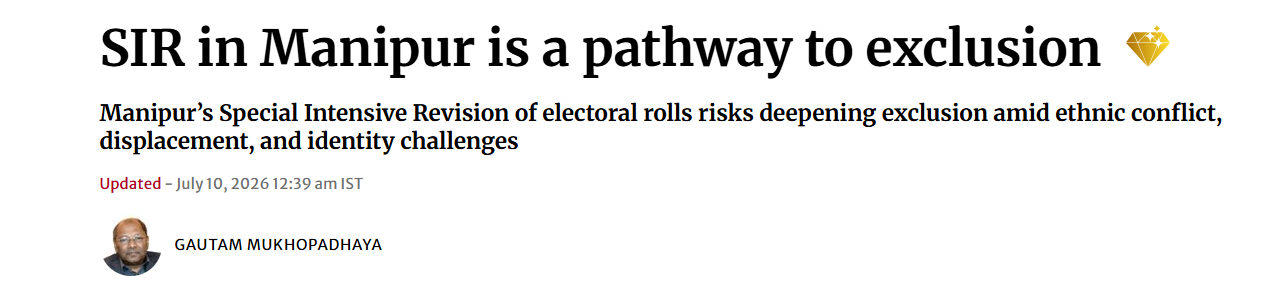
For example, concerns have been raised regarding displaced populations in Manipur, where large numbers of citizens have lost access to personal documents.
Concerns Raised by Former CEC S.Y. Quraishi
Former Chief Election Commissioner S.Y. Quraishi has criticised the present approach, arguing that the SIR appears to prioritise exclusion over inclusion.
His principal concerns include:
- Electoral administration should presume inclusion rather than exclusion.
- Documentation requirements should remain reasonable.
- Administrative errors should not deprive citizens of voting rights.
- Electoral roll revision should strengthen, not weaken, democratic participation.
He has cautioned that democracy ultimately depends on maximising genuine voter participation rather than merely reducing statistical inaccuracies.
Government and Election Commission’s Response
The Election Commission has rejected allegations that the SIR is intended to disenfranchise citizens.
According to the Commission:
Ensuring Clean Electoral Rolls
The primary objective is to eliminate:
- duplicate entries,
- deceased voters,
- shifted electors,
- fraudulent registrations.
Accurate electoral rolls improve electoral credibility.
Constitutional Responsibility
The Election Commission maintains that preparing correct electoral rolls is a constitutional obligation under Article 324.
Failure to remove inaccuracies could itself undermine free and fair elections.
Opportunity to Respond
The Commission has emphasised that:
- names are not deleted automatically,
- notices are issued before deletion,
- electors receive opportunities to submit documents,
- appeals are available against adverse decisions.
Technology-Based Verification
Digital databases, GIS mapping, Aadhaar-linked verification (where legally permissible), and online services are intended to reduce errors and improve transparency.
Uniform Application
The Election Commission maintains that the process applies uniformly across all electors and is not targeted at any particular community.
Balancing Electoral Integrity and Inclusion
The debate surrounding SIR reflects two equally important democratic values.
Electoral Integrity
Democracy requires:
- clean voter lists,
- prevention of fraud,
- elimination of duplicate voting,
- accurate electoral records.
Democratic Inclusion
At the same time, democracy demands that:
- every eligible citizen is able to vote,
- bureaucratic procedures remain citizen-friendly,
- documentation barriers do not become barriers to democracy.
An excessive emphasis on exclusion risks weakening public trust in democratic institutions.
A balanced electoral revision process should seek both accuracy and inclusion.
Key reforms may include:
Simplified Documentation
Alternative forms of identity verification should be accepted, particularly for vulnerable groups.
Better Public Awareness
Citizens should receive timely information regarding required documents, deadlines, and appeal mechanisms.
Strengthening Booth Level Officers
Adequate staffing, training, and technological support should be provided to reduce administrative errors.
Independent Monitoring
Civil society observers and independent audits may improve transparency and public confidence.
Special Protection for Vulnerable Groups
Dedicated procedures should be developed for:
- migrants,
- internally displaced persons,
- tribal populations,
- elderly citizens,
- persons with disabilities,
- homeless individuals.
Strong Appeal Mechanisms
Fast, accessible, and inexpensive grievance redressal systems should ensure that no eligible voter loses voting rights without due process.
Use of Technology with Safeguards
Digital verification should complement—not replace—human verification, while ensuring privacy, transparency, and data protection.
The Special Intensive Revision represents one of the most significant electoral exercises undertaken in recent years. Its objective of maintaining accurate electoral rolls is both legitimate and constitutionally supported. Free and fair elections require clean voter lists, and the Election Commission has a statutory duty to ensure their integrity. However, electoral integrity cannot come at the cost of democratic inclusion. When documentation requirements become excessively burdensome or administrative processes fail to accommodate India’s diverse socio-economic realities, genuine citizens may face the risk of exclusion. Such outcomes would undermine the very democratic values that electoral reforms seek to protect.
The challenge, therefore, is not whether electoral rolls should be revised, but how they should be revised. A rights-based approach—grounded in transparency, procedural fairness, natural justice, and accessibility—can reconcile the twin goals of electoral accuracy and universal franchise. As former Chief Election Commissioner S.Y. Quraishi has cautioned, electoral reforms should strengthen democracy by expanding legitimate participation rather than narrowing it. Ultimately, the success of the SIR process will be judged not merely by the number of incorrect names removed, but by its ability to ensure that every eligible citizen retains an equal opportunity to participate in India’s democratic process.