

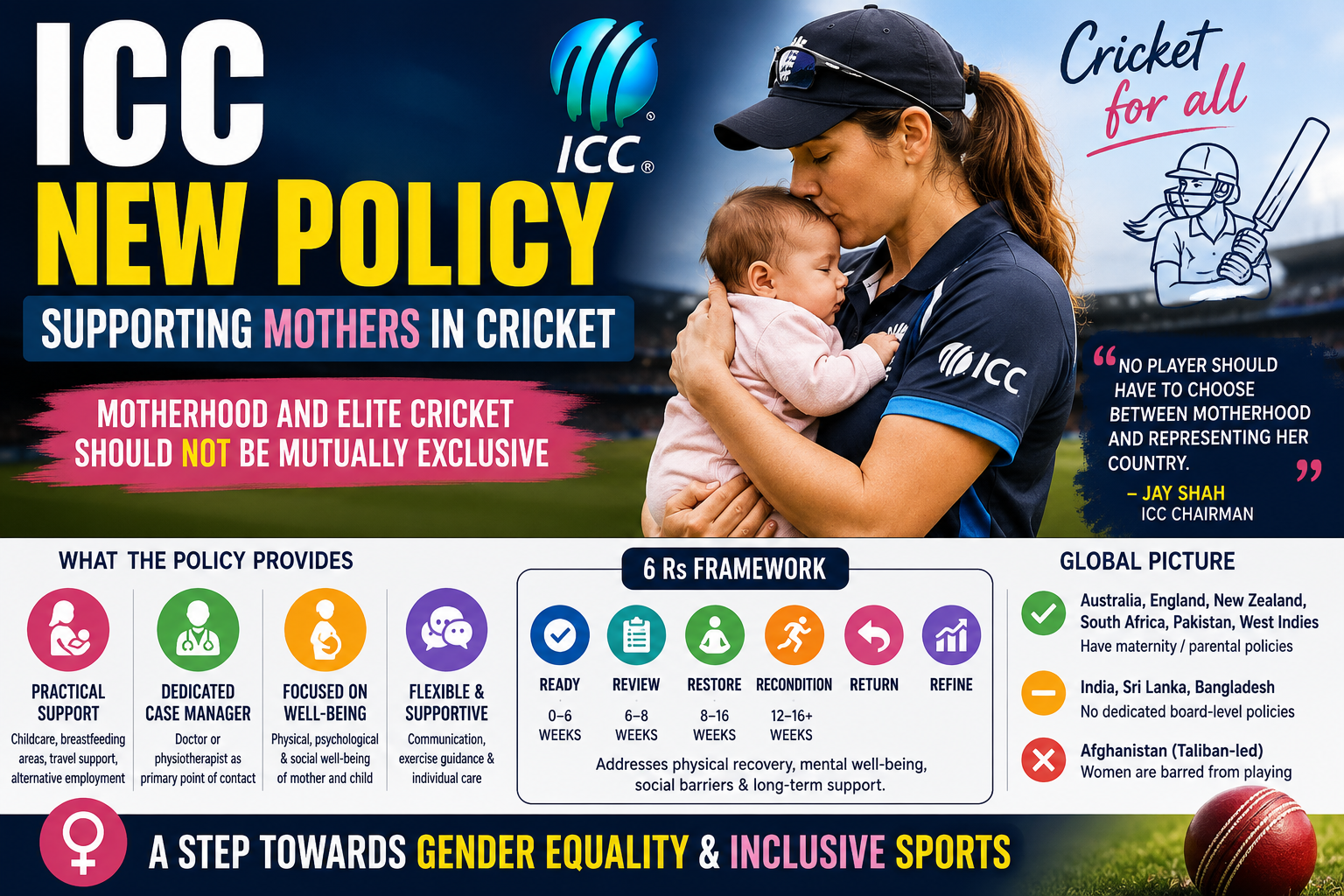

Why was this policy necessary? What does it entail?
From a sociological perspective, the ICC’s Return to Play Post-Pregnancy Guidelines can be analysed using concepts such as gender inequality, patriarchy, feminism, work-family balance, motherhood penalty, social institutions, and social inclusion. Return to Play Post-Pregnancy Guidelines
ICC Return to Play Post-Pregnancy Guidelines: A Sociological Analysis
1. Gender Equality in Sports
The ICC guidelines represent an important step toward gender equality by recognizing that motherhood should not prevent women from pursuing professional sports. Traditionally, sports institutions have been designed around male career patterns, often ignoring women’s reproductive roles. The policy attempts to reduce this structural disadvantage.
Relevant Thinkers
- Liberal Feminism (Betty Friedan): Advocates equal opportunities through institutional reforms.
- Amartya Sen – Capability Approach: Expands women’s real freedom and capability to participate in sports.
2. Motherhood Penalty
The article highlights the motherhood penalty, where women experience career interruptions, reduced earnings, and fewer professional opportunities after childbirth. In sociology, this reflects structural gender discrimination rather than individual failure.
Concept
- Women often face a “double burden” of productive work and reproductive responsibilities. Return to Play Post-Pregnancy Guidelines.
Relevant Thinkers
- Arlie Hochschild: Second Shift – women perform paid work while carrying unpaid domestic responsibilities.
- Sylvia Walby: Patriarchy operates through institutions such as family and employment.
3. Patriarchy and Gender Roles
Historically, women athletes have been expected to choose between family and career because society assigns childcare primarily to women. This reflects patriarchal norms that define motherhood as a woman’s primary identity.
The ICC policy challenges these traditional gender expectations by institutionalizing support systems.
4. Functionalist Perspective
From a functionalist viewpoint, the policy strengthens the sports institution by ensuring experienced athletes remain active after childbirth.
Benefits include:
- Retention of skilled players.
- Improved diversity.
- Better organizational efficiency.
- Positive role models for future generations.
This contributes to the stability and continuity of the sporting system.
5. Conflict Perspective
Conflict theorists argue that sports organizations historically reflected unequal power relations, privileging male athletes.
The maternity policy redistributes organizational resources through:
- Paid support
- Childcare
- Flexible work arrangements
- Medical assistance
Thus, it reduces institutional inequality.
6. Symbolic Interactionism
The statement “Motherhood and elite cricket should not be mutually exclusive” seeks to redefine the social meaning attached to motherhood.
Instead of viewing mothers as less committed athletes, the policy reconstructs motherhood as compatible with professional excellence.
This changes everyday interactions, organizational culture, and public perception.
7. Social Inclusion
The guidelines promote inclusive institutions by accommodating diverse life experiences rather than expecting everyone to follow a single career path.
Support measures include:
- Childcare facilities
- Breastfeeding spaces
- Travel assistance
- Alternative employment
- Mental health support
These reduce barriers to participation.
8. Welfare State and Institutional Support
The ICC recognizes that motherhood is not merely a private family issue but also an institutional responsibility.
This reflects the principle of social welfare, where organizations provide social protection to vulnerable groups.
9. Intersectionality
Support varies significantly across countries:
- Australia has comprehensive maternity policies.
- India, Sri Lanka, and Bangladesh lack dedicated board-level policies.
- Afghanistan prohibits women from playing cricket.
This demonstrates how gender intersects with political systems, culture, and institutional development, creating unequal experiences for women athletes.
Relevant Thinker
- Kimberlé Crenshaw: Intersectionality explains overlapping forms of inequality.
10. Social Change
The ICC policy reflects broader social transformations:
- Growing recognition of women’s rights.
- Institutional acceptance of work-life balance.
- Expansion of gender-sensitive labour policies.
- Greater representation of women in public life.
It signifies a shift from formal equality to substantive equality, where institutions actively remove barriers faced by women. Return to Play Post-Pregnancy Guidelines.
Relevant Sociological Concepts
- Gender Equality
- Patriarchy
- Feminism
- Motherhood Penalty
- Second Shift
- Work-Life Balance
- Social Inclusion
- Institutional Support
- Gender Division of Labour
- Capability Approach
- Welfare
- Intersectionality
- Social Change
- Gender Mainstreaming
Thinkers You Can Quote
- Betty Friedan – Liberal Feminism
- Sylvia Walby – Patriarchy
- Arlie Hochschild – Second Shift
- Kimberlé Crenshaw – Intersectionality
- Amartya Sen – Capability Approach
- Nancy Fraser – Recognition and Redistribution
- Pierre Bourdieu – Institutional reproduction of inequality
The ICC’s Return to Play Post-Pregnancy Guidelines illustrate the transition from formal equality to substantive equality in sports governance. By addressing the motherhood penalty, reducing patriarchal institutional barriers, and providing social support mechanisms such as childcare, breastfeeding facilities, mental health services, and flexible return-to-play protocols, the policy promotes gender justice, social inclusion, and capability enhancement. It reflects the feminist demand that reproductive roles should not limit women’s participation in public institutions and demonstrates how organizational reforms can foster more equitable and inclusive sporting environments. Return to Play Post-Pregnancy Guidelines.