

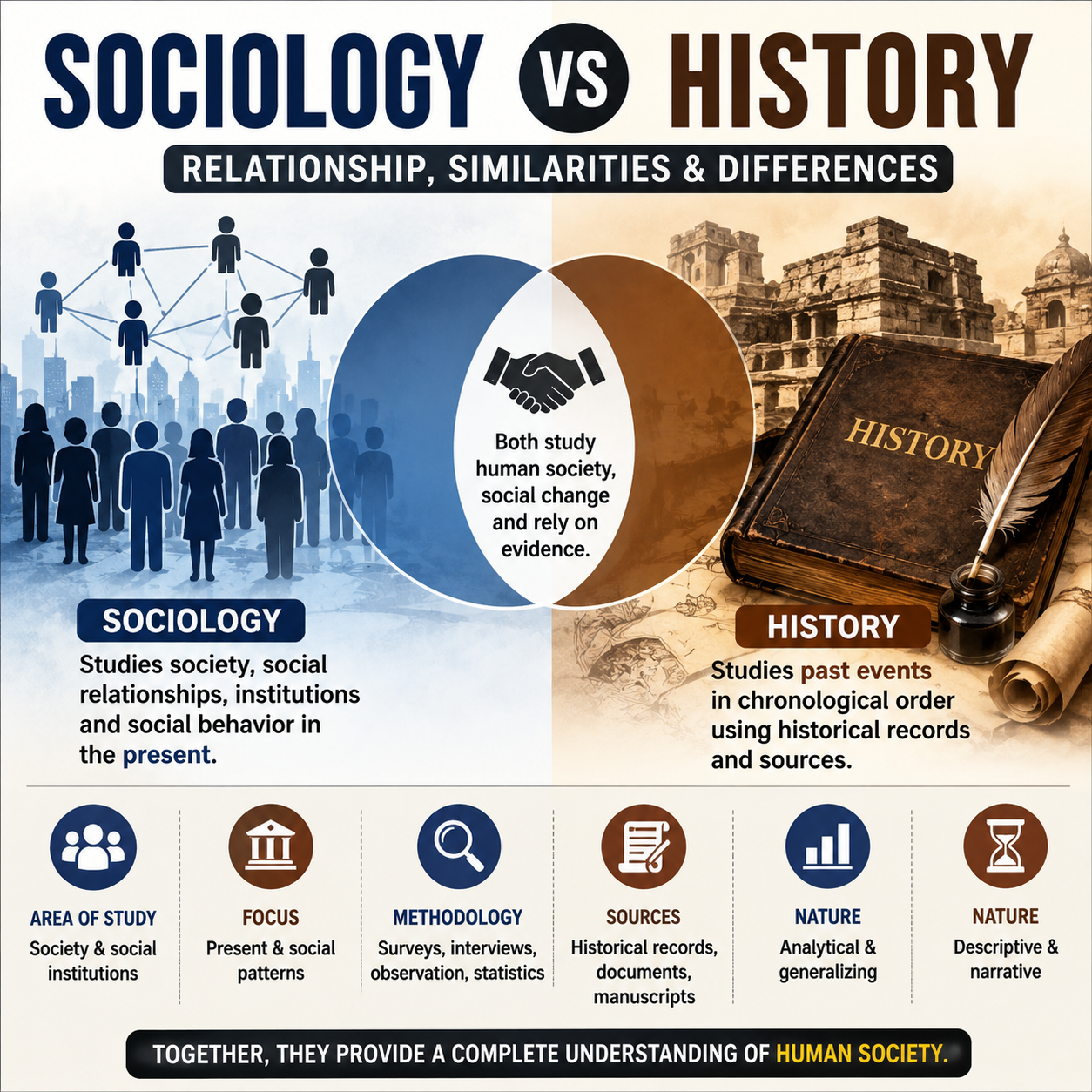

Sociology and History are closely related social sciences that study human society and social life. While History focuses on past events and their chronological development, Sociology studies social relationships, institutions, and patterns of behavior. Both disciplines complement each other in understanding society.
Similarities between Sociology and History
- Study of Human Society
- Both examine human actions, social institutions, and collective life.
- Concern with Social Change
- Both analyze how societies transform over time.
- Interdisciplinary Relationship
- Historical data helps sociologists understand social processes.
- Sociological concepts help historians interpret historical events.
- Use of Empirical Evidence
- Both rely on evidence, records, documents, and observations.
Differences between Sociology and History
| Basis | Sociology | History |
|---|---|---|
| Area of Study | Studies social relationships, institutions, and social behavior. | Studies past events and their chronological development. |
| Focus | Concerned with present society and recurring social patterns. | Concerned primarily with unique past events. |
| Nature | Analytical and generalizing. | Descriptive and narrative. |
| Methodology | Uses surveys, interviews, observation, and statistical analysis. | Uses archival records, documents, manuscripts, and historical sources. |
| Objective | Formulates general theories and social laws. | Reconstructs and interprets historical events. |
Sociology and History as Complementary Disciplines
- Historical context enriches sociological analysis.
- Sociology provides theoretical frameworks for historical interpretation.
- Historical Sociology combines both approaches to study long-term social change.
Thus, Sociology and History are distinct yet interdependent disciplines. History provides the temporal dimension of social life, while Sociology offers analytical tools to understand social structures and processes. Together, they contribute to a comprehensive understanding of human society.