


Introduction
One of the most important decisions in the UPSC Civil Services Examination (CSE) journey is selecting the right optional subject. Every year thousands of aspirants spend months preparing for General Studies, Current Affairs, Essay, and CSAT, but the optional subject remains the single most influential factor in determining the final rank.
Unlike General Studies papers, which are common for all candidates, the Optional Subject is the only paper that candidates can choose according to their interests, academic background, and strengths. The marks obtained in the optional papers are directly counted in the final merit list and often become the deciding factor between selection and non-selection.
Many successful candidates have emphasized that a well-chosen optional subject can provide a significant advantage in the UPSC Mains Examination. In General Studies, the variation between candidates is usually limited, whereas in Optional Subjects, score differences of 40–60 marks are common.
Therefore, selecting the best optional subject for UPSC CSE 2027 requires careful analysis of success rates, syllabus length, availability of study material, overlap with General Studies, personal interest, and scoring potential.
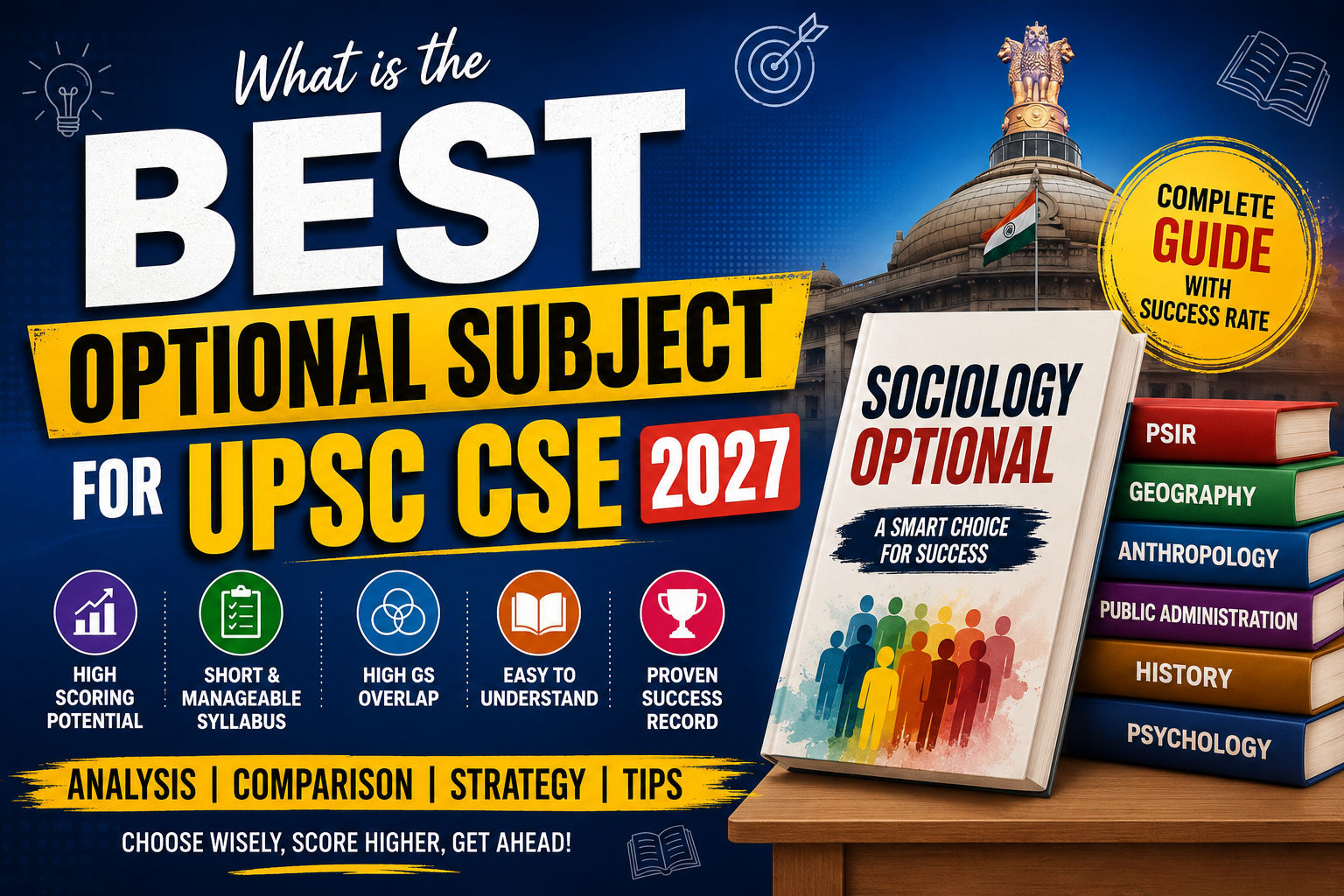
This comprehensive guide discusses all major optional subjects, success rates, preparation strategies, Sociology Optional advantages, and expert recommendations to help aspirants make an informed choice.
1. List of UPSC Optional Subjects
The UPSC allows candidates to choose any one optional subject from the following list:
Humanities and Social Science Subjects
- Anthropology
- Geography
- History
- Political Science and International Relations (PSIR)
- Sociology
- Public Administration
- Psychology
- Philosophy
- Law
- Economics
Science Subjects
- Agriculture
- Animal Husbandry and Veterinary Science
- Botany
- Chemistry
- Geology
- Mathematics
- Medical Science
- Physics
- Statistics
- Zoology
Engineering Subjects
- Civil Engineering
- Electrical Engineering
- Mechanical Engineering
Commerce and Management
- Commerce and Accountancy
- Management
Literature Subjects
Candidates may choose literature of any one language including:
- English Literature
- Hindi Literature
- Urdu Literature
- Marathi Literature
- Bengali Literature
- Tamil Literature
- Telugu Literature
- Sanskrit Literature
- Punjabi Literature
- Malayalam Literature
- Kannada Literature
- Assamese Literature
- Gujarati Literature
- Odia Literature
- Nepali Literature
- Kashmiri Literature
- Dogri Literature
- Konkani Literature
- Sindhi Literature
- Manipuri Literature
- Maithili Literature
- Santhali Literature
- Bodo Literature
All optional papers are descriptive in nature and each paper carries 250 marks, making a total of 500 marks.
2. Optional Subject Success Rate Analysis
Success rate is one of the factors aspirants often consider while selecting an optional subject.
According to UPSC data:
| Subject | Success Rate |
|---|---|
| Animal Husbandry | 18.8% |
| Kannada Literature | 13.7% |
| Malayalam Literature | 12.4% |
| Management | 11.1% |
| Urdu Literature | 11.1% |
| Commerce & Accountancy | 10.9% |
| Economics | 10.7% |
| Agriculture | 10.5% |
| Medical Science | 10.5% |
| Law | 10.2% |
| Sociology | 10.0% |
| Anthropology | 9.1% |
| Psychology | 9.1% |
| Mathematics | 8.3% |
| PSIR | 8.2% |
| Public Administration | 8.2% |
| History | 6.8% |
| Philosophy | 6.2% |
| Geography | 5.5% |
Most Popular Optional Subjects
The most preferred optional subjects among UPSC aspirants are:
- Geography
- Political Science and International Relations (PSIR)
- Sociology
- Anthropology
- Public Administration
- History
Popularity does not always mean higher success rates. Many aspirants choose Geography due to its overlap with General Studies despite its comparatively lower success rate.
Should Success Rate Be the Only Criterion?
No.
A high success rate may result from a smaller number of candidates appearing in that subject. Therefore, aspirants should never choose an optional solely based on success rate.
Instead, success rate should be considered alongside:
- Interest in the subject
- Availability of study material
- Guidance availability
- Syllabus length
- GS overlap
- Writing skills
3. How to Choose the Right Optional Subject
Choosing the correct optional subject is one of the most strategic decisions in UPSC preparation.
A. Interest in the Subject
The first criterion should be your genuine interest.
UPSC preparation is a long journey involving hundreds of hours of study. A subject you enjoy studying will keep you motivated and consistent.
Aspirants who select a subject merely because others recommend it often lose interest midway.
Questions to ask:
- Do I enjoy reading this subject?
- Can I study it for one year continuously?
- Does the subject excite me intellectually?
If the answer is yes, the subject deserves consideration.
B. Scoring Potential
Some subjects have consistently produced high scores.
Examples include:
- Sociology
- Anthropology
- Mathematics
- Public Administration
- Literature Subjects
- PSIR
A scoring subject provides an advantage in final rankings.
However, a scoring subject only becomes beneficial when properly prepared.
C. Overlap with General Studies
Subjects overlapping with GS save preparation time.
Examples:
Sociology
Overlap with:
- Society
- Social Issues
- Essay
- Ethics
- Interview
PSIR
Overlap with:
- Polity
- Governance
- International Relations
- Essay
Geography
Overlap with:
- Environment
- Disaster Management
- Physical Geography
D. Length of Syllabus
Some subjects have concise syllabi.
Examples:
- Sociology
- Anthropology
- Philosophy
Some subjects have very extensive syllabi.
Examples:
- History
- Geography
- Law
Shorter syllabi allow multiple revisions.
E. Availability of Study Material
A good optional should have:
- Standard books
- Coaching notes
- Previous year solutions
- Test series
- Mentor guidance
Without proper resources, preparation becomes difficult.
F. Writing Skills
Humanities subjects require strong analytical writing.
Examples:
- Sociology
- PSIR
- History
- Public Administration
Candidates with excellent writing skills often perform exceptionally well in these subjects.
4. Why Sociology Optional is One of the Best Optional Subjects
Among all optional subjects, Sociology Optional has emerged as one of the most preferred and successful choices.
Reasons Behind Sociology’s Popularity
1. Short and Manageable Syllabus
Compared to Geography or History, Sociology has a concise syllabus.
The entire syllabus can be completed in a few months.
2. High Scoring Potential
Many toppers have scored 300+ marks in Sociology Optional.
The subject rewards conceptual clarity and answer-writing skills.
3. Significant GS Overlap
Sociology overlaps with:
- Society
- Social Justice
- Women Issues
- Poverty
- Education
- Globalization
- Urbanization
- Social Movements
This overlap helps in:
- GS Paper 1
- GS Paper 2
- Essay
- Ethics
- Interview
4. Easy for Beginners
No prior academic background is required.
Candidates from:
- Engineering
- Science
- Commerce
- Arts
can easily understand Sociology.
5. Rich Content Availability
There are abundant:
- Books
- Notes
- Test Series
- Coaching Material
available for Sociology Optional.
6. Dynamic Yet Stable
Sociology combines static theory with current affairs.
This makes answers unique and contemporary.
7. Useful Beyond UPSC
Sociology improves understanding of:
- Society
- Politics
- Culture
- Social Change
- Governance
which is valuable for future administrators.
5. Preparation Strategy for UPSC Optional Subject
A proper strategy is essential.
Step 1: Complete the Syllabus
First complete the entire syllabus without skipping topics.
Avoid selective preparation.
UPSC frequently asks questions from neglected areas.
Step 2: Build Conceptual Understanding
Read standard books.
Focus on:
- Concepts
- Thinkers
- Theories
- Applications
Memorization alone is insufficient.
Step 3: Make Notes
Prepare concise notes.
Notes should contain:
- Definitions
- Thinkers
- Examples
- Diagrams
- Current Affairs
Step 4: Integrate Current Affairs
Use:
- Government Reports
- NITI Aayog Reports
- NFHS Data
- Census Data
- Economic Survey
These enhance answer quality.
Step 5: Practice Previous Year Questions
Previous year questions reveal:
- UPSC trends
- Repeated themes
- Important topics
No optional preparation is complete without PYQs.
Step 6: Answer Writing
Answer writing is the key to scoring.
Practice:
- 10 markers
- 15 markers
- 20 markers
Focus on:
- Structure
- Analysis
- Examples
- Conclusion
Step 7: Test Series
Join a quality test series.
Benefits include:
- Time management
- Feedback
- Evaluation
- Improvement tracking
6. Common Mistakes While Choosing an Optional
Following Friends
Many aspirants choose the same optional as their friends.
This often leads to regret.
Choosing Based on Trends
Today’s popular subject may not remain popular tomorrow.
Choose according to suitability.
Ignoring Interest
A subject studied without interest becomes a burden.
Looking Only at Success Rate
Success rate alone is misleading.
Suitability matters more.
Ignoring Syllabus Length
A huge syllabus can affect revision.
Always evaluate syllabus size.
Not Checking Resources
Study material availability is crucial.
Overestimating Academic Background
Graduation subject is helpful but not mandatory.
Many engineers excel in Sociology and PSIR.
7. Frequently Asked Questions (FAQs)
Which is the best optional subject for UPSC?
There is no universally best optional. Sociology, Anthropology, PSIR, Geography, Public Administration, and Psychology are among the most popular choices.
Is Sociology Optional good for UPSC?
Yes. Sociology Optional is considered one of the best optional subjects due to its short syllabus, high scoring potential, GS overlap, and easy availability of resources.
Which optional has the highest success rate?
Among major subjects, Sociology, Law, Economics, Agriculture, and Medical Science have consistently shown strong success rates.
Can engineers choose Sociology Optional?
Absolutely. Thousands of engineering graduates successfully choose Sociology Optional every year.
How much time is required for Optional preparation?
Approximately 700–1000 hours including study, revision, answer writing, and mock tests.
Is coaching necessary?
No. Many successful candidates clear UPSC through self-study, provided they have quality material and answer-writing practice.
Conclusion
The Optional Subject is arguably the most decisive component of the UPSC Civil Services Examination. A wisely chosen optional can significantly improve your final rank and increase your chances of selection.
When selecting an optional subject, focus on interest, scoring potential, syllabus length, resource availability, and overlap with General Studies. Avoid blindly following trends or choosing subjects solely based on success rates.
Among the various options available, Sociology Optional continues to remain one of the most balanced choices because of its concise syllabus, strong overlap with General Studies, high scoring potential, and relevance to contemporary social issues.
Ultimately, the best optional subject for UPSC CSE 2027 is the one that matches your aptitude, interest, and preparation strategy. With dedication, answer-writing practice, and proper guidance, any optional subject can become a scoring optional and help you achieve your dream of becoming a civil servant.
One response to “Best Optional Subject for UPSC CSE 2027: Complete Guide to Choosing the Right Optional Subject”
Thnx