


Introduction
Karl Marx (1818–1883) is one of the most influential thinkers in Sociology, Political Science, Economics, and Philosophy. His ideas transformed the understanding of society, power, inequality, and social change. For UPSC Sociology Optional aspirants, Marx occupies a central position under Paper-I: Sociological Thinkers, and his concepts frequently appear in both Paper-I and Paper-II answers.
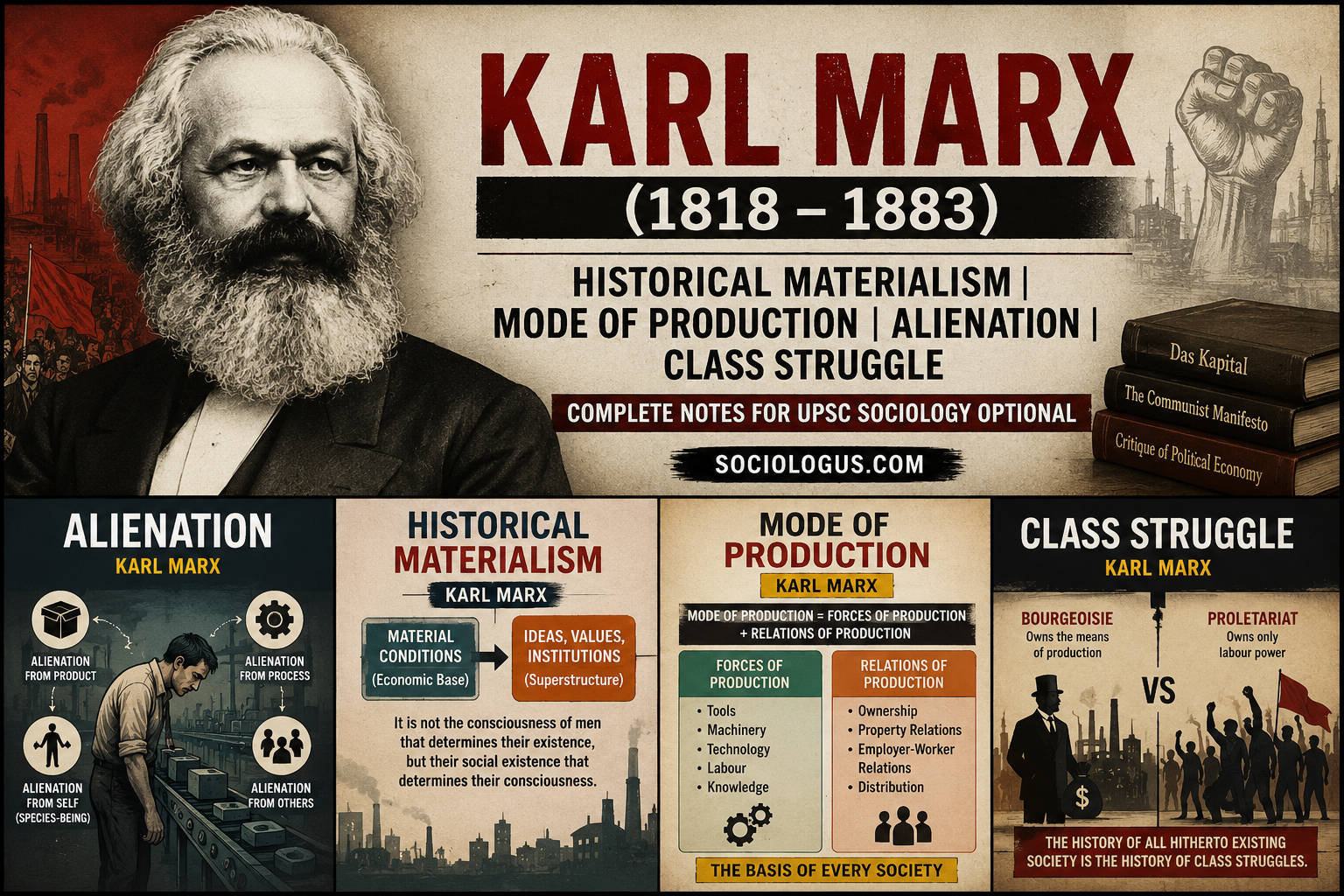
Marx’s sociological contribution lies in his attempt to explain how societies develop, why inequalities persist, and what drives social change. Unlike idealist philosophers who emphasized the role of ideas, Marx argued that material conditions and economic relations are the foundation of society. According to him, history is not driven by great individuals or abstract ideas but by struggles between social classes over the control of economic resources.
His theories of Historical Materialism, Mode of Production, Alienation, and Class Struggle continue to influence contemporary debates on globalization, capitalism, labour rights, inequality, technology, and social movements. Even today, sociologists use Marxian concepts to analyze economic disparities, corporate dominance, labour exploitation, and class inequalities across the world.
Karl Marx: Life and Intellectual Background
Karl Marx was born on 5 May 1818 in Trier, Prussia (present-day Germany). He studied law and philosophy at the Universities of Bonn and Berlin. During his student life, he came into contact with the ideas of G.W.F. Hegel, whose philosophy significantly shaped his intellectual development.
Marx worked as a journalist and political activist before devoting himself to research and writing. Along with his lifelong collaborator Friedrich Engels, he produced several revolutionary works including:
- The Communist Manifesto (1848)
- The German Ideology (1846)
- Economic and Philosophic Manuscripts (1844)
- Das Kapital (1867)
Throughout his life, Marx remained critical of capitalism and sought to understand the mechanisms through which exploitation and inequality were reproduced in society.
Intellectual Influences on Karl Marx
1. Hegel’s Dialectics
Marx borrowed the concept of dialectics from Hegel.
According to Hegel:
- History develops through contradictions.
- Ideas shape reality.
- Human progress occurs through the conflict of ideas.
Marx accepted the dialectical method but rejected Hegel’s idealism.
He argued:
“It is not ideas that determine material conditions; rather material conditions determine ideas.”
Thus Marx transformed Hegel’s Dialectical Idealism into Dialectical Materialism.
2. Classical Political Economy
Economists like Adam Smith and David Ricardo influenced Marx’s understanding of labour, value, and production.
Marx adopted and modified the labour theory of value, arguing that labour creates value while capitalists appropriate surplus value generated by workers.
3. French Socialist Thought
The ideas of French revolutionaries and socialist thinkers inspired Marx’s vision of a classless and egalitarian society.
Their emphasis on equality, fraternity, and collective ownership influenced Marx’s critique of capitalism.
Historical Materialism
Meaning
Historical Materialism is Marx’s theory of history and social change.
It seeks to explain how societies develop through changes in their economic structures.
According to Marx:
The production of material life forms the basis of all social, political, and intellectual processes.
Human beings must produce food, shelter, clothing, and other necessities to survive. Therefore, economic production becomes the foundation of society.
Why is it Historical?
Marx traced the development of human societies through different historical stages.
He argued that every society passes through distinct phases based on its mode of production.
Thus the theory is historical because it studies the evolution of societies over time.
Why is it Materialistic?
Marx believed that material conditions, rather than ideas, drive historical development.
For him:
- Economic structures shape social institutions.
- Material realities influence consciousness.
- Social change originates from economic contradictions.
Therefore, history is fundamentally shaped by material forces.
Infrastructure and Superstructure
One of Marx’s most famous contributions is the distinction between infrastructure and superstructure.
Infrastructure (Economic Base)
The infrastructure includes:
- Forces of production
- Relations of production
It constitutes the economic foundation of society.
Superstructure
The superstructure includes:
- State
- Legal institutions
- Religion
- Education
- Family
- Culture
- Ideology
According to Marx, these institutions emerge from and serve the interests of the economic base.
Relationship Between Base and Superstructure
Marx argued that:
Economic Base → Shapes → Superstructure
For example:
- Feudal economies produced feudal political systems.
- Capitalist economies produce capitalist laws and institutions.
Thus the economic structure influences the character of social institutions.
Mode of Production
The concept of Mode of Production is central to Marx’s theory.
A Mode of Production refers to the way goods and services are produced within a society.
It consists of:
1. Forces of Production
The forces of production include:
- Tools
- Machinery
- Technology
- Labour power
- Scientific knowledge
- Skills
These determine society’s productive capacity.
2. Relations of Production
Relations of production refer to:
- Ownership patterns
- Property relations
- Employer-worker relations
- Distribution of resources
These define how people interact during production.
Formula
Mode of Production = Forces of Production + Relations of Production
Historical Stages of Development
Marx viewed history as a sequence of changing modes of production.
1. Primitive Communism
Characteristics:
- Collective ownership
- No private property
- No classes
- Cooperation and equality
People produced collectively and shared resources.
There was no exploitation because productive forces were limited.
2. Slave Society
As productivity increased, private property emerged.
Characteristics:
- Masters owned slaves.
- Slaves performed productive labour.
- Society became divided into classes.
This marked the beginning of institutionalized exploitation.
3. Feudal Society
Feudalism emerged after the decline of slavery.
Characteristics:
- Land owned by feudal lords.
- Serfs worked on land.
- Agricultural economy dominated.
The feudal lord appropriated surplus produced by peasants.
4. Capitalist Society
Capitalism emerged through industrialization.
Characteristics:
- Means of production owned by bourgeoisie.
- Workers sell labour power.
- Production for profit.
- Wage labour dominates.
According to Marx, capitalism is highly productive but inherently exploitative.
5. Socialist Society
Marx predicted that capitalism would eventually collapse.
Workers would seize control over production.
Characteristics:
- Collective ownership
- End of exploitation
- Planned production
6. Communist Society
The final stage of human development.
Characteristics:
- Stateless society
- Classless society
- Common ownership
- Human freedom and equality
According to Marx:
“From each according to his ability, to each according to his needs.”
Forces and Relations of Production
The interaction between forces and relations of production drives social change.
Forces of Production
Include:
- Technology
- Machinery
- Human labour
- Knowledge
These constantly evolve.
Relations of Production
Include:
- Property ownership
- Control over resources
- Class relationships
These tend to remain conservative.
Contradiction
As productive forces develop, existing relations of production become obstacles.
For example:
Industrial technology developed within feudal society.
Feudal property relations restricted further growth.
Result:
- French Revolution
- Industrial Capitalism
Thus contradictions generate revolutionary transformations.
Dialectical Materialism
Marx adopted the dialectical method from Hegel.
Every social order contains internal contradictions.
Thesis
Existing social system.
Antithesis
Opposing forces generated within the system.
Synthesis
Resolution creating a new social order.
Example:
Feudalism → Capitalism → Socialism
Thus social change is a result of dialectical contradictions.
Alienation
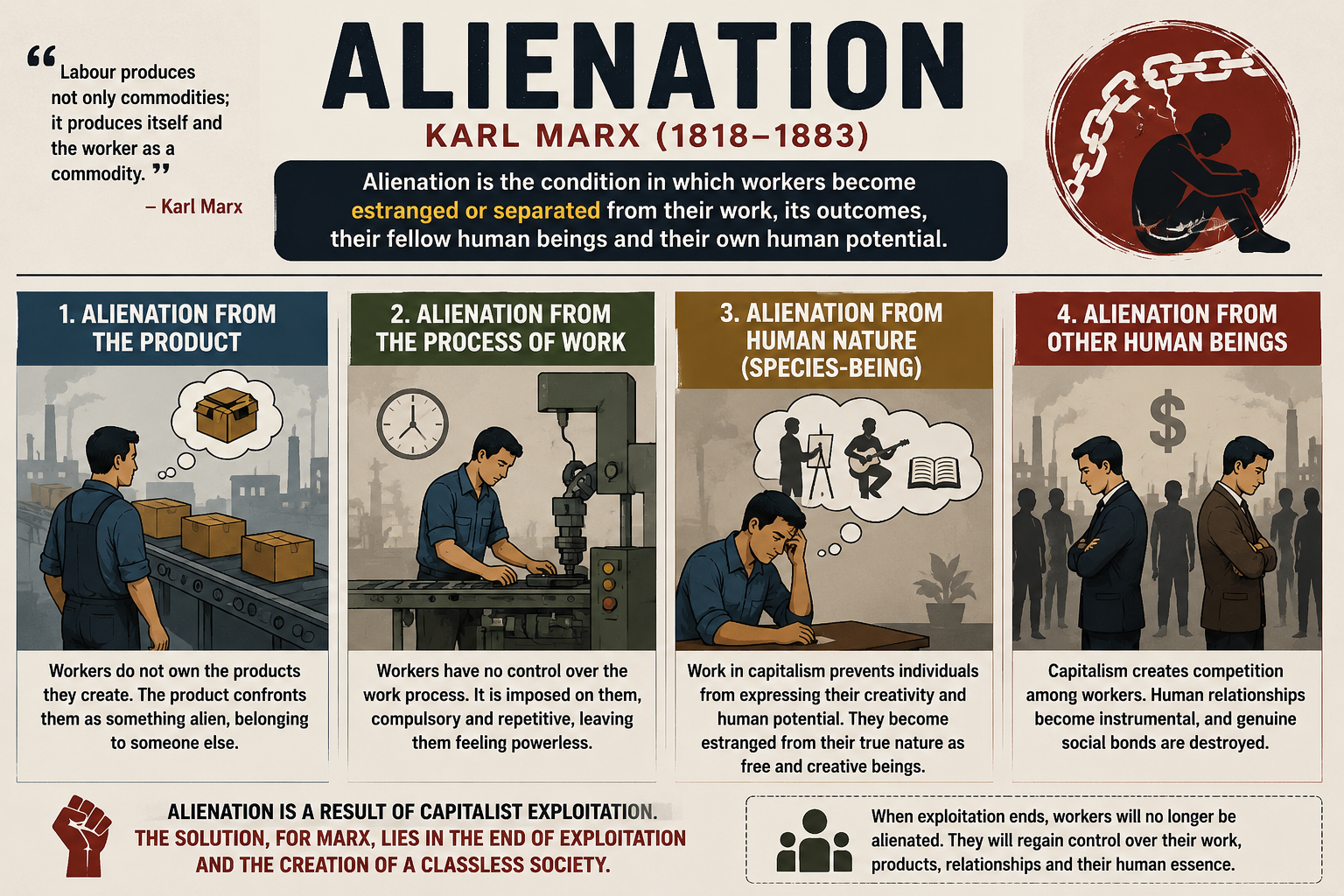
Alienation is one of Marx’s most important concepts.
Alienation means separation or estrangement.
In capitalist societies workers become alienated from:
- Their products
- Their labour
- Their fellow humans
- Their own human nature
Alienation from Product
Workers create products but do not own them.
The finished product belongs to the capitalist.
Example:
A worker assembles cars but cannot claim ownership of the cars.
Thus the product becomes an alien object.
Alienation from Production Process
Workers have little control over production.
Tasks are fragmented and repetitive.
Decision-making remains with management.
Work becomes mechanical and monotonous.
Alienation from Species-Being
Human beings are naturally creative.
Meaningful labour should express human creativity.
Capitalism reduces workers to machines.
As a result, individuals become alienated from their true human potential.
Alienation from Fellow Humans
Competition replaces cooperation.
Workers compete for wages and jobs.
Social relationships become market relationships.
People begin to value others based on economic worth.
Religion and Alienation
Marx famously described religion as:
“The opium of the people.”
He believed religion offers comfort but also prevents people from understanding the real causes of their suffering.
Religion diverts attention away from material inequalities.
Thus it contributes to alienation.
Contemporary Relevance of Alienation
Alienation remains visible today.
Examples include:
Gig Economy
Workers have little job security or workplace control.
Call Centres
Employees must display artificial emotions.
Platform Labour
Delivery workers are controlled by algorithms.
Corporate Work
Workers often feel disconnected from final outcomes.
Thus alienation continues in modern capitalism.
Class and Class Struggle
Marx believed:
“The history of all hitherto existing society is the history of class struggles.”
Every society contains classes with opposing interests.
Meaning of Class
Class refers to a group sharing a common relationship to the means of production.
Those who own resources form one class.
Those who work form another.
Bourgeoisie
The capitalist class.
Owns:
- Factories
- Land
- Technology
- Capital
Controls production and profits.
Proletariat
The working class.
Owns only labour power.
Must sell labour in exchange for wages.
Class in Itself
A group sharing similar economic conditions.
Example:
Factory workers.
They may not yet recognize their common interests.
Class for Itself
Workers develop class consciousness.
They become aware of exploitation.
They organize and struggle collectively.
This transforms a class in itself into a class for itself.
Class Consciousness
Class consciousness refers to awareness of shared interests.
Workers realize:
- They are exploited.
- Their interests differ from capitalists.
- Collective action is necessary.
This awareness is essential for social revolution.
Theory of Exploitation
Marx argued that capitalism survives through exploitation.
Workers produce more value than they receive in wages.
The difference is called:
Surplus Value
Example:
Worker produces value worth ₹1000.
Worker receives wages of ₹400.
Remaining ₹600 becomes profit.
This surplus value is appropriated by the capitalist.
Thus exploitation becomes structural.
Class Conflict
Class conflict emerges because classes have opposing interests.
Capitalists Want
- Higher profits
- Lower wages
Workers Want
- Better wages
- Better working conditions
Therefore conflict becomes inevitable.
Revolution
Marx argued that class conflict eventually culminates in revolution.
Workers overthrow capitalist domination.
New relations of production emerge.
Revolution is therefore the mechanism of historical change.
Contribution of Karl Marx to Sociology
Marx made several enduring contributions:
1. Conflict Perspective
Introduced conflict as a central sociological concept.
2. Class Analysis
Provided systematic understanding of inequality.
3. Economic Sociology
Connected economy with social structure.
4. Social Change
Developed a comprehensive theory of social transformation.
5. Critical Sociology
Inspired critical analysis of power and domination.
Criticism of Marx
Max Weber
Weber argued that ideas and values can influence economic development.
His study of Protestantism challenged economic determinism.
Functionalists
Functionalists argued that society is based on consensus rather than conflict.
Economic Determinism
Critics argue Marx overemphasized economic factors.
Politics, culture, religion, and identity also influence society.
Failure of Communist States
Many critics point to the collapse of several communist regimes as evidence against Marx’s predictions.
Middle Class Expansion
Modern capitalism has produced large middle classes, which Marx underestimated.
Contemporary Relevance for UPSC Sociology
Marx remains highly relevant for understanding:
- Economic inequality
- Corporate capitalism
- Globalization
- Labour exploitation
- Gig economy
- Digital capitalism
- Privatization
- Wealth concentration
- Social movements
Current debates around wealth inequality, labour rights, and corporate power continue to draw heavily upon Marxian analysis.
Conclusion
Karl Marx remains one of the foundational thinkers of Sociology. Through Historical Materialism, Mode of Production, Alienation, and Class Struggle, he developed a comprehensive framework for understanding society and social change. His emphasis on economic structures, power relations, and class conflict transformed sociological thinking and continues to influence contemporary research across the world.
Despite criticisms, Marx’s ideas remain indispensable for analyzing inequality, exploitation, globalization, labour relations, and social transformation. For UPSC Sociology Optional aspirants, a deep understanding of Marx is essential not only for scoring high marks in Paper-I but also for enriching answers related to social stratification, economic development, social change, and contemporary social issues.
- BASIC CONCEPTS OF SOCIOLOGY UGC NET SOCIOLOGY NOTES
- Q. In what way does Queer Kinship challenge the Traditional Kinship System? Substantiate by giving Illustrations. (UPSC CSE Sociology Optional | 10 Marks)
- Q. How do Civil Society Organizations such as NGOs and Self-Help Groups contribute to Grassroot Level Social Changes? Discuss. (UPSC CSE Sociology Optional | 20 Marks)
- Q. What do you understand by Sustainable Development? Discuss the elements of Sustainable Development as proposed in the UNDP’s Sustainable Development Goals Report, 2015. (UPSC CSE Sociology Optional | 20 Marks)
- Q. What is the Nature of Relationship between Science and Religion in Modern Society? Analyze with Suitable Examples. (UPSC CSE Sociology Optional | 10 Marks)