


Introduction
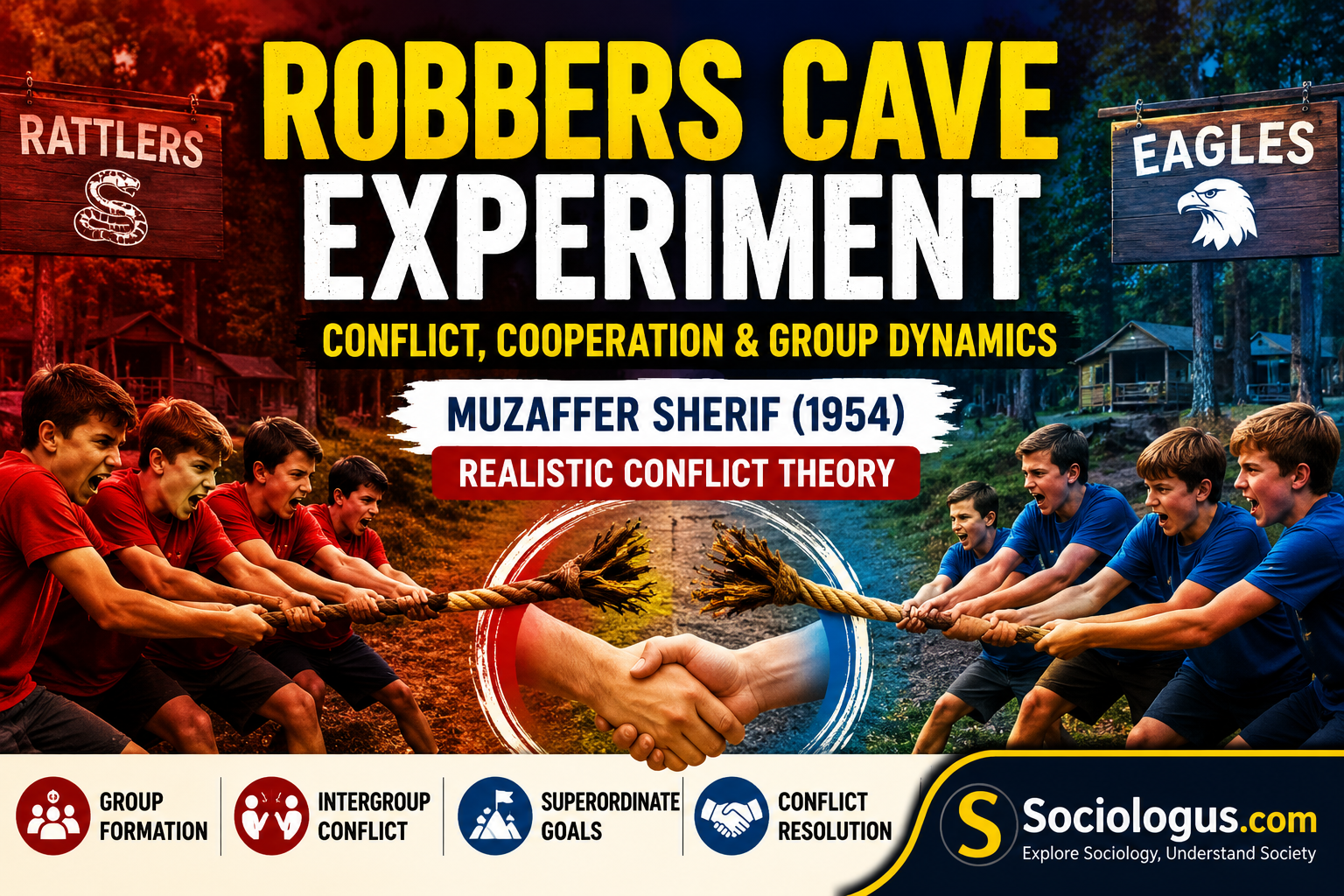
The Robbers Cave Experiment is one of the most famous studies in social psychology and sociology. Conducted by Turkish-American social psychologist Muzafer Sherif in 1954, the experiment demonstrated how group identities, competition, and cooperation influence human behavior. The study remains highly relevant for understanding social conflict, prejudice, communal tensions, nationalism, and group dynamics in contemporary societies. https://en.wikipedia.org/wiki/Muzafer_Sherif
The experiment was conducted at Robbers Cave State Park in Oklahoma, USA, from which it derives its name. Sherif sought to examine how conflicts arise between groups and how such conflicts can be reduced.
Background of the Experiment
During the mid-twentieth century, scholars were interested in understanding the causes of prejudice, discrimination, and intergroup hostility. Existing theories often focused on individual psychology. Sherif believed that group conflict could emerge naturally from competition over limited resources and goals.
To test this idea, he designed a controlled field experiment involving young boys at a summer camp.
Objectives of the Study
The primary objectives were:
- To understand how group identities are formed.
- To examine how competition creates hostility between groups.
- To identify methods for reducing intergroup conflict.
- To test the Realistic Conflict Theory.
Methodology
Participants
- Twenty-two boys aged 11–12 years participated.
- All came from similar middle-class backgrounds.
- The participants were physically and mentally healthy.
- None knew each other before the experiment.
Location
The study was conducted at Robbers Cave State Park in Oklahoma, United States.
Experimental Design
The experiment was divided into three phases:
- Group Formation Stage
- Friction Stage
- Integration Stage
Phase 1: Group Formation
The boys were randomly divided into two groups and housed separately.
Initially, neither group was aware of the existence of the other.
Within a few days:
- Group leaders emerged naturally.
- Group norms developed.
- Members formed close friendships.
- Each group created its own identity.
The groups selected names:
The Eagles
and
The Rattlers
They developed flags, slogans, and symbols, strengthening their sense of belonging.
Sociological Significance
This phase demonstrated how social groups create collective identities and establish norms even without external influence.
Phase 2: Intergroup Conflict (Friction Stage)
After strong group identities had formed, the researchers introduced competition.
Competitive activities included:
- Tug-of-war
- Baseball games
- Treasure hunts
- Athletic contests
Prizes were awarded only to the winning group.
Outcomes
Very quickly:
- Hostility emerged.
- Members insulted each other.
- Stereotypes developed.
- Property was damaged.
- Physical confrontations occurred.
The Eagles and Rattlers began viewing each other as enemies.
Sociological Interpretation
Competition for scarce rewards generated conflict.
This finding supported Sherif’s Realistic Conflict Theory, which argues that conflict emerges when groups compete for limited resources or goals.
Phase 3: Conflict Resolution (Integration Stage)
Researchers first attempted to reduce hostility through simple social interaction.
Examples included:
- Shared meals
- Movies
- Recreational activities
However, these measures failed to eliminate prejudice.
The researchers then introduced “superordinate goals.”
What Are Superordinate Goals?
Superordinate goals are objectives that cannot be achieved by one group alone and require cooperation between groups.
Examples included:
Repairing a Water Supply
The camp’s water system was intentionally disrupted. Both groups had to work together to restore it.
Moving a Broken Truck
The boys cooperated to pull a truck carrying food supplies.
Pooling Resources
Both groups contributed money to rent a movie.
Results
Gradually:
- Hostility decreased.
- Friendships developed across groups.
- Cooperation increased.
- Group boundaries weakened.
By the end of the experiment, many boys preferred traveling home together.
Realistic Conflict Theory
The Robbers Cave Experiment provided strong support for Realistic Conflict Theory.
Key Assumptions
- Competition creates conflict.
- Cooperation reduces hostility.
- Group interests influence behavior.
- Scarce resources increase tensions.
According to Sherif, prejudice is not merely an individual attitude but often a product of social and structural conditions.
Major Findings
1. Group Identity Develops Quickly
People naturally form group identities even among strangers.
2. Competition Generates Conflict
Limited rewards and competition create hostility and prejudice.
3. Stereotypes Are Socially Constructed
Negative stereotypes emerged despite participants having similar backgrounds.
4. Cooperation Reduces Conflict
Shared goals can overcome divisions.
5. Social Context Matters
Behavior is influenced by group situations rather than personality alone.
Relevance in Sociology
The experiment helps sociologists understand:
Communal Conflicts
Competition for political power and resources can create tensions among communities.
Ethnic Rivalries
Ethnic groups may develop prejudice when competing for jobs, land, or status.
Nationalism
Nations often strengthen internal unity through comparison with external groups.
Workplace Competition
Departments and teams may experience conflict when rewards are limited.
Educational Institutions
Student groups may form identities and rivalries based on competition.
Criticisms of the Experiment
Despite its significance, the study has faced criticism.
Ethical Concerns
Participants were unaware of the true purpose of the study.
Artificial Manipulation
Researchers deliberately created conflict situations.
Limited Sample
Only young boys from similar backgrounds were studied.
Generalization Issues
Results may not fully represent adults, women, or diverse societies.
Contemporary Relevance
The Robbers Cave Experiment remains relevant in understanding:
- Religious conflicts
- Ethnic tensions
- Political polarization
- Workplace rivalries
- International conflicts
- Social media group behavior
The study highlights the importance of cooperation, dialogue, and shared objectives in maintaining social harmony.
Conclusion
The Robbers Cave Experiment remains a landmark study in sociology and social psychology. Muzafer Sherif demonstrated that group conflict often arises from competition over resources and goals, while cooperation through superordinate goals can reduce hostility and promote social integration. The findings continue to provide valuable insights into prejudice, discrimination, group identity, and conflict resolution in modern societies.
Quick Revision Points for UPSC & UGC NET
- Conducted by: Muzafer Sherif (1954)
- Location: Robbers Cave State Park, Oklahoma
- Participants: 22 boys aged 11–12
- Groups: Eagles and Rattlers
- Theory Supported: Realistic Conflict Theory
- Three Stages:
- Group Formation
- Friction/Conflict
- Integration/Cooperation
- Key Concept: Superordinate Goals
- Major Finding: Competition creates conflict; cooperation reduces hostility.
- Q. In what way does Queer Kinship challenge the Traditional Kinship System? Substantiate by giving Illustrations. (UPSC CSE Sociology Optional | 10 Marks)
- Q. How do Civil Society Organizations such as NGOs and Self-Help Groups contribute to Grassroot Level Social Changes? Discuss. (UPSC CSE Sociology Optional | 20 Marks)
- Q. What do you understand by Sustainable Development? Discuss the elements of Sustainable Development as proposed in the UNDP’s Sustainable Development Goals Report, 2015. (UPSC CSE Sociology Optional | 20 Marks)
- Q. What is the Nature of Relationship between Science and Religion in Modern Society? Analyze with Suitable Examples. (UPSC CSE Sociology Optional | 10 Marks)
- Q. How do Marx, Weber and Durkheim differ in Understanding Religion? Explain. (UPSC CSE Sociology Optional | 20 Marks)