

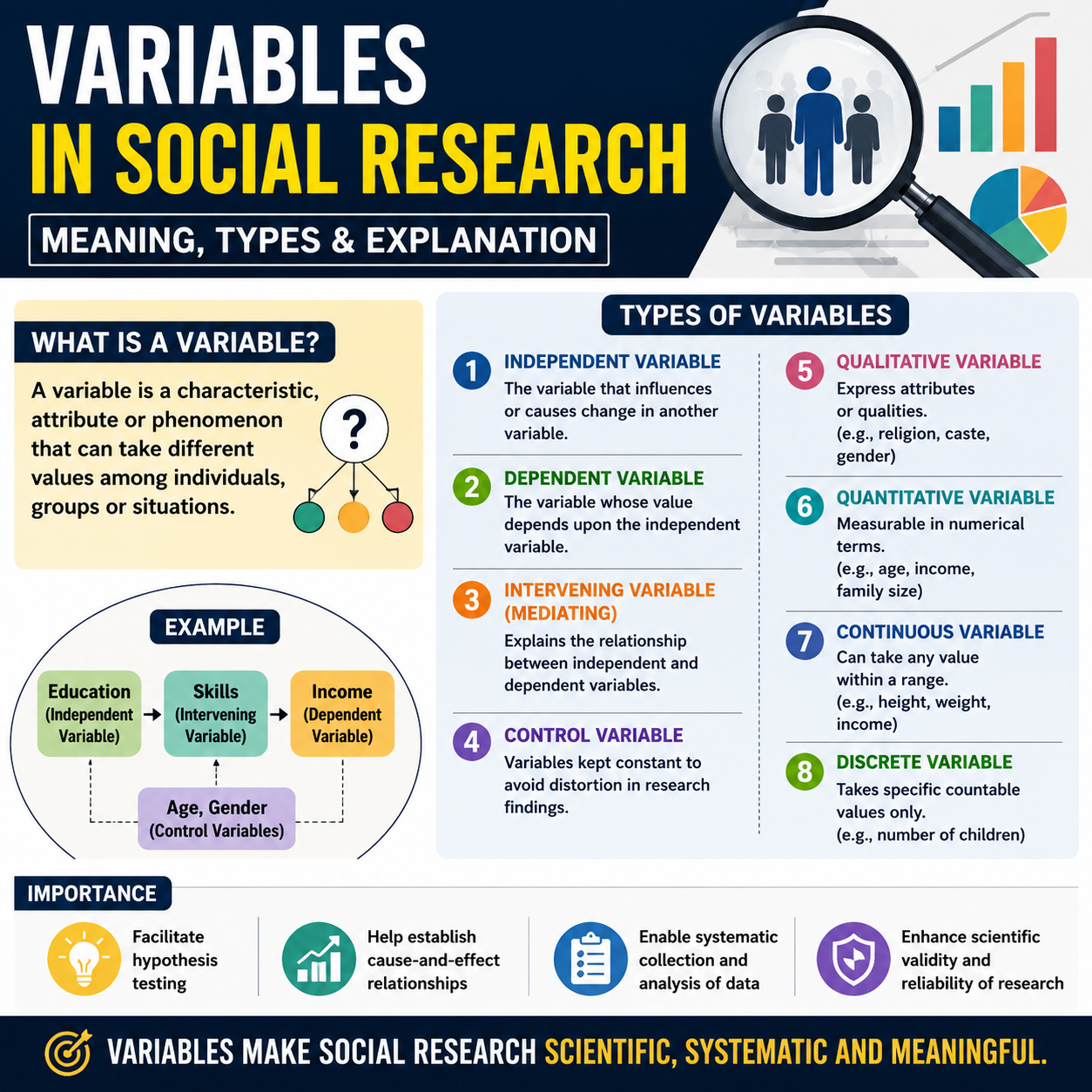

A variable is a characteristic, attribute, or phenomenon that can take different values among individuals, groups, or situations. It is a fundamental concept in social research because it helps researchers measure, compare, and explain social phenomena scientifically.
Meaning of Variable
- A variable is any factor that varies from one individual or group to another.
- Examples: age, gender, income, education, occupation, social class, and political participation.
- Variables enable researchers to formulate hypotheses and test relationships between social phenomena.
Types of Variables
1. Independent Variable
- The variable that influences or causes change in another variable.
- Example: Level of education affecting income.
2. Dependent Variable
- The variable whose value depends upon the independent variable.
- Example: Income level influenced by education.
3. Intervening (Mediating) Variable
- A variable that explains the relationship between independent and dependent variables.
- Example: Skills acquired through education affecting income.
4. Control Variable
- Variables kept constant to avoid distortion in research findings.
- Example: Age and gender controlled while studying education and income.
5. Qualitative Variables
- Express attributes or qualities.
- Examples: Religion, caste, gender, marital status.
6. Quantitative Variables
- Measurable in numerical terms.
- Examples: Age, income, family size.
7. Continuous Variables
- Can take any value within a range.
- Example: Height, weight, income.
8. Discrete Variables
- Take specific countable values only.
- Example: Number of children in a family.
Importance of Variables
- Facilitate hypothesis testing.
- Help establish cause-and-effect relationships.
- Enable systematic collection and analysis of data.
- Enhance scientific validity and reliability of research.
Thus, variables are the building blocks of social research. By identifying and measuring different types of variables, sociologists can systematically investigate social phenomena, test theories, and generate reliable knowledge about society.