


What is Stoicism? The Ancient Philosophy That Can Transform Modern Life
In a world filled with uncertainty, competition, stress, social media comparisons, financial pressures, and endless distractions, one ancient philosophy has quietly survived for more than two thousand years because of its timeless relevance. That philosophy is Stoicism. It is not merely a collection of quotations or motivational sayings; it is a practical way of living that teaches people how to remain calm during chaos, rational during conflict, and resilient during adversity. Stoicism reminds us that while we cannot always choose what happens to us, we can always choose how we respond. This simple yet profound insight has inspired emperors, soldiers, philosophers, entrepreneurs, athletes, and ordinary individuals seeking a meaningful life.
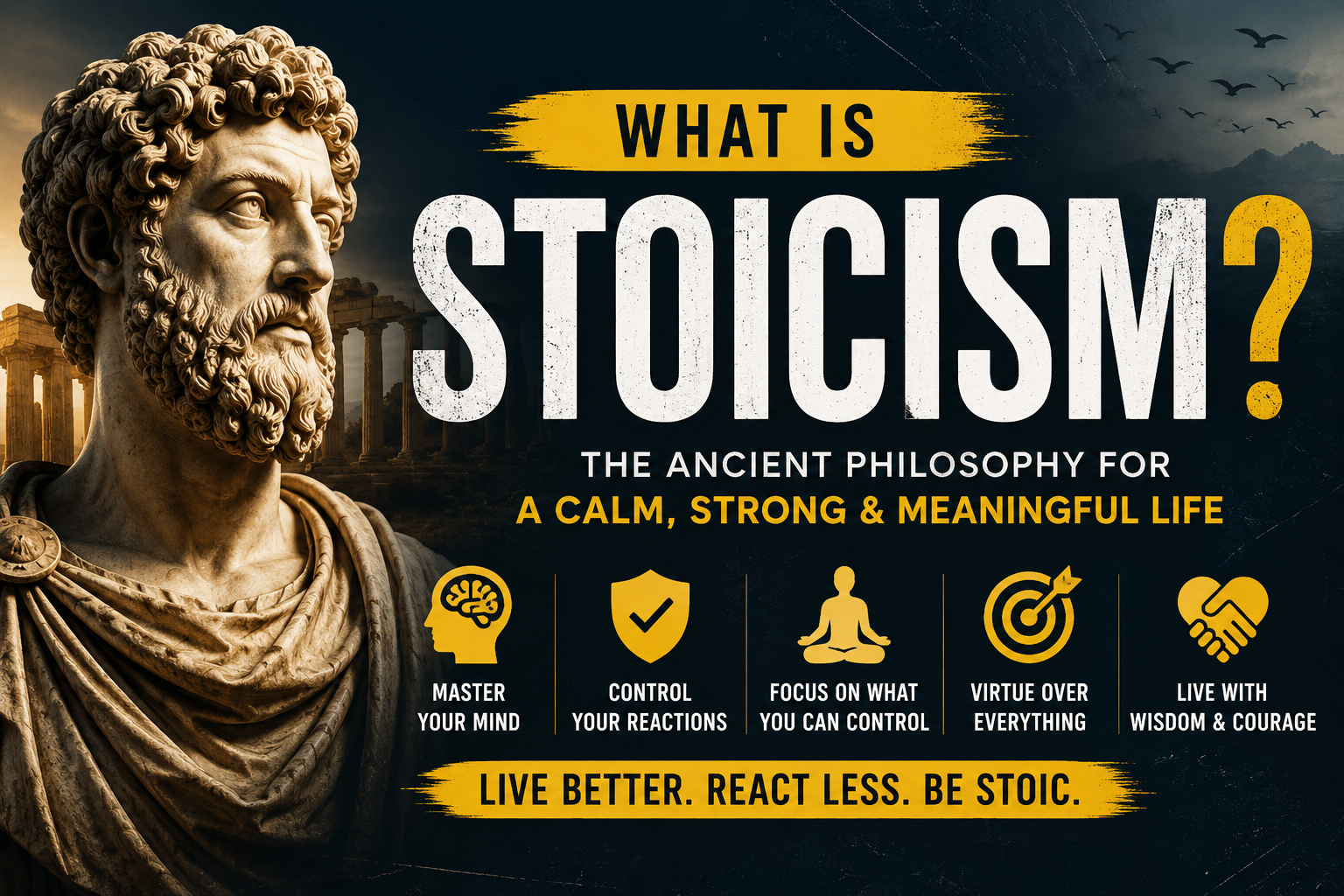
What it really means? Stoicism is a philosophy that teaches that human suffering arises less from events themselves and more from our reactions to them. It distinguishes between what is within our control (thoughts, choices, actions, attitudes) and what is outside our control (fortune, reputation, outcomes, other people). The Stoic aim is not emotional numbness, but inner freedom through reason, self-mastery and moral integrity.
Preparing for UPSC Sociology Optional?
Access handwritten notes, toppers’ strategies, PYQs, answer-writing resources, thinkers, and complete Sociology study material designed to help you score higher in UPSC Mains.
At its core, Stoicism is the philosophy of inner freedom. It argues that most human suffering does not arise directly from external events but from the meanings and judgments we attach to them. Two people may experience the same setback—one sees it as the end of everything, while the other treats it as an opportunity to grow. The event remains identical; only the response changes. Stoicism therefore teaches that peace is not found by controlling the world but by mastering oneself.
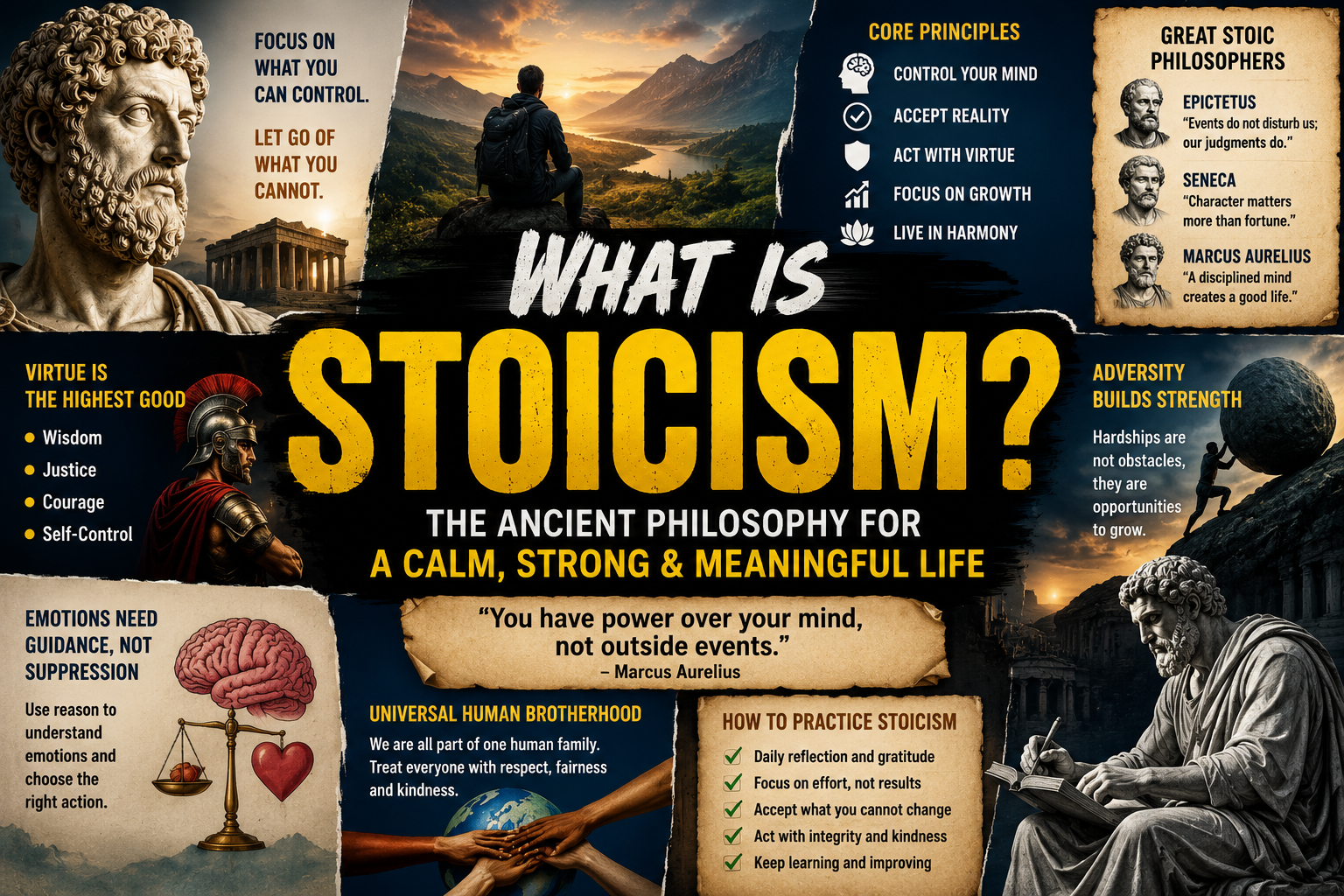
The most fundamental principle of Stoicism is the distinction between what is within our control and what is outside our control. Our thoughts, choices, attitudes, actions, values, and intentions belong to us. Wealth, fame, reputation, other people’s opinions, economic conditions, political events, accidents, and even many outcomes of our own efforts do not. Much of human anxiety comes from trying to control what can never truly be controlled. A Stoic instead focuses entirely on what lies within personal responsibility and accepts everything else with dignity and wisdom.
This philosophy does not encourage passivity or laziness. On the contrary, Stoicism demands excellence in action. A student must prepare sincerely for an examination, but cannot guarantee the result. An entrepreneur should build the best possible business but cannot predict every market condition. A civil servant should formulate sound public policies, yet cannot control every consequence. Success, according to Stoicism, lies in giving one’s best effort without becoming emotionally dependent on the outcome.
One of the greatest misconceptions about Stoicism is that it teaches emotional suppression or indifference. This is false. Stoicism never asks people to stop feeling emotions. Instead, it teaches them to understand emotions before acting upon them. Anger, fear, jealousy, greed, and anxiety are natural human experiences. The Stoic question is not whether emotions exist but whether they deserve control over our decisions. Reason should guide emotion rather than emotion governing reason. A calm mind makes wiser decisions than an impulsive one.
Imagine a leader making decisions during a national crisis. If fear dominates judgment, panic spreads. If anger controls policy, injustice follows. If pride blinds reason, mistakes multiply. Stoicism therefore emphasizes emotional discipline because societies, organizations, and families often suffer when decisions emerge from uncontrolled emotions rather than thoughtful reflection.
Another defining principle of Stoicism is the belief that virtue is the highest good. Modern society often measures success through income, luxury, popularity, and influence. Stoicism challenges this assumption by arguing that true success lies in character. Wisdom, justice, courage, honesty, integrity, and self-control are more valuable than wealth or fame because external possessions can disappear overnight, while character remains the foundation of a meaningful life.
A wealthy individual without integrity may possess comfort but not respect. A powerful leader without justice may command fear but never admiration. A successful businessperson without honesty may accumulate profit but lose trust. Stoicism insists that external achievements gain real value only when guided by moral excellence. It is character—not fortune—that determines the quality of life.
Hardship occupies a special place in Stoic philosophy. Most people view obstacles as interruptions to happiness. Stoicism views them as opportunities for growth. Difficulties strengthen resilience, patience, courage, and wisdom in the same way physical exercise strengthens muscles. Comfort rarely develops greatness; challenges often do.
History repeatedly confirms this insight. Nations rebuild after disasters. Scientists learn from failed experiments. Athletes improve after defeat. Entrepreneurs grow through unsuccessful ventures. Students mature after examination failures. Personal setbacks often become turning points that reveal hidden strength. Stoicism therefore teaches that obstacles should not merely be endured but used as instruments for personal transformation. The obstacle itself becomes the path toward improvement.
One famous Stoic principle beautifully captures this idea: “The obstacle is the way.” Instead of asking, “Why has this happened to me?” Stoicism encourages asking, “What can this situation teach me?” Such a shift transforms suffering into learning and failure into preparation for future success.
Read Our Best Pages :
UPSC CALENDER
UPSC MAINS SYLLABUS
Stoicism also encourages simplicity in an age dominated by materialism and consumer culture. Modern life constantly persuades people that happiness lies in purchasing more, earning more, displaying more, and comparing more. Social media intensifies this tendency by presenting carefully curated images of success and luxury. Stoicism warns that dependence on external possessions creates fragile happiness because everything external can change. Wealth may disappear, popularity may fade, careers may fluctuate, and circumstances may reverse.
True contentment, according to Stoicism, comes from developing an inner life independent of external possessions. Gratitude, discipline, purpose, meaningful relationships, and self-respect create happiness that remains stable even during uncertain times. This does not mean rejecting wealth or ambition. Rather, Stoicism teaches that people should own possessions without allowing possessions to own them.
The philosophy also promotes the idea of universal human brotherhood. Stoic thinkers believed that all human beings share the same rational nature and belong to one universal community. Differences of nationality, language, religion, ethnicity, or social status should never overshadow our shared humanity. Every individual deserves dignity because every person participates in the same human condition.
This principle remains remarkably relevant today. Climate change, global pandemics, technological disruption, migration, conflict, and international trade all demonstrate that humanity’s future is interconnected. Stoicism encourages cooperation over division, dialogue over hatred, and justice over prejudice. It reminds us that lasting peace cannot emerge from selfishness alone but from recognizing our common responsibilities toward one another.
Among the great Stoic philosophers, Epictetus taught perhaps the most influential lesson: “It is not things themselves that disturb us, but our judgments about them.” Born into slavery, Epictetus understood hardship better than most philosophers. Yet he argued that external circumstances could never imprison the human mind unless individuals surrendered their judgment.
Seneca, the Roman statesman and philosopher, emphasized that fortune constantly changes, but character remains the only reliable possession. Wealth, power, and influence are temporary gifts; integrity is permanent. His writings continue to inspire discussions on leadership, ethics, governance, and responsible public life.
Marcus Aurelius, the philosopher-emperor of Rome, demonstrated Stoicism not merely through words but through leadership. Governing a vast empire while facing wars, disease, and political instability, he reflected that individuals possess power over their minds, not over external events. His personal journal, Meditations, remains one of history’s greatest guides to self-discipline, humility, and resilience.
Stoicism has profound relevance in modern education, governance, business, and personal development. For students preparing for competitive examinations, it encourages focusing on disciplined preparation instead of obsessing over results. For leaders, it teaches calm judgment under pressure. For professionals, it emphasizes ethical conduct over personal gain. For families, it promotes patience, understanding, and emotional maturity. For societies, it offers a philosophy that reduces conflict by encouraging reason over anger and dialogue over hostility.
In public administration, Stoicism reminds policymakers that wise restraint is often as valuable as decisive action. In business, it encourages long-term integrity instead of short-term profit. In sports, it teaches athletes to value effort over medals. In relationships, it encourages understanding before reaction. In everyday life, it transforms ordinary challenges into opportunities for personal excellence.
Perhaps the greatest gift of Stoicism is the realization that freedom begins within. External circumstances will never become perfectly favorable. There will always be uncertainty, criticism, failure, disappointment, and change. Waiting for a flawless world before becoming happy means waiting forever. Stoicism instead teaches that peace begins the moment individuals stop surrendering their happiness to events beyond their control.
As Marcus Aurelius wisely observed, “You have power over your mind—not outside events.” Epictetus added, “It is not things themselves that disturb us, but our judgments about them.” Together, these timeless insights reveal the heart of Stoicism: human greatness is not measured by the absence of difficulties but by the quality of one’s response.
Ultimately, Stoicism is not about escaping the world; it is about facing it with courage. It is not about becoming emotionless; it is about becoming emotionally intelligent. It is not about rejecting ambition; it is about pursuing excellence without becoming enslaved by outcomes. It is not about avoiding hardship; it is about discovering strength through hardship. Above all, Stoicism teaches that while we cannot command every event life presents, we can always command our character, our choices, and our response—and within that response lies the true foundation of wisdom, resilience, ethics, happiness, and lasting inner peace.
- BASIC CONCEPTS OF SOCIOLOGY UGC NET SOCIOLOGY NOTES
- Q. In what way does Queer Kinship challenge the Traditional Kinship System? Substantiate by giving Illustrations. (UPSC CSE Sociology Optional | 10 Marks)
- Q. How do Civil Society Organizations such as NGOs and Self-Help Groups contribute to Grassroot Level Social Changes? Discuss. (UPSC CSE Sociology Optional | 20 Marks)
- Q. What do you understand by Sustainable Development? Discuss the elements of Sustainable Development as proposed in the UNDP’s Sustainable Development Goals Report, 2015. (UPSC CSE Sociology Optional | 20 Marks)
- Q. What is the Nature of Relationship between Science and Religion in Modern Society? Analyze with Suitable Examples. (UPSC CSE Sociology Optional | 10 Marks)
Best Pages :
UPSC CALENDER 2027
UPSC MAINS SYLLABUS