


Peter Pan Syndrome: Meaning, Symptoms, Causes, Examples, and Sociological Perspective
Peter Pan Syndrome: Why Some Adults Never Want to Grow Up
In today’s fast-changing world, adulthood brings increasing responsibilities related to careers, relationships, finances, and family life. While many people gradually accept these responsibilities, some struggle to transition into mature adulthood. This pattern is commonly referred to as Peter Pan Syndrome.
Peter Pan Syndrome describes adults who avoid responsibilities, fear commitment, depend heavily on others, and continue behaving in emotionally immature ways. Although Peter Pan Syndrome is widely discussed in psychology, popular culture, and sociology, it is not officially recognized as a mental disorder in major psychiatric diagnostic manuals.
This article explores Peter Pan Syndrome from psychological and sociological perspectives, helping readers understand its causes, symptoms, effects, and possible solutions.
What is Peter Pan Syndrome?
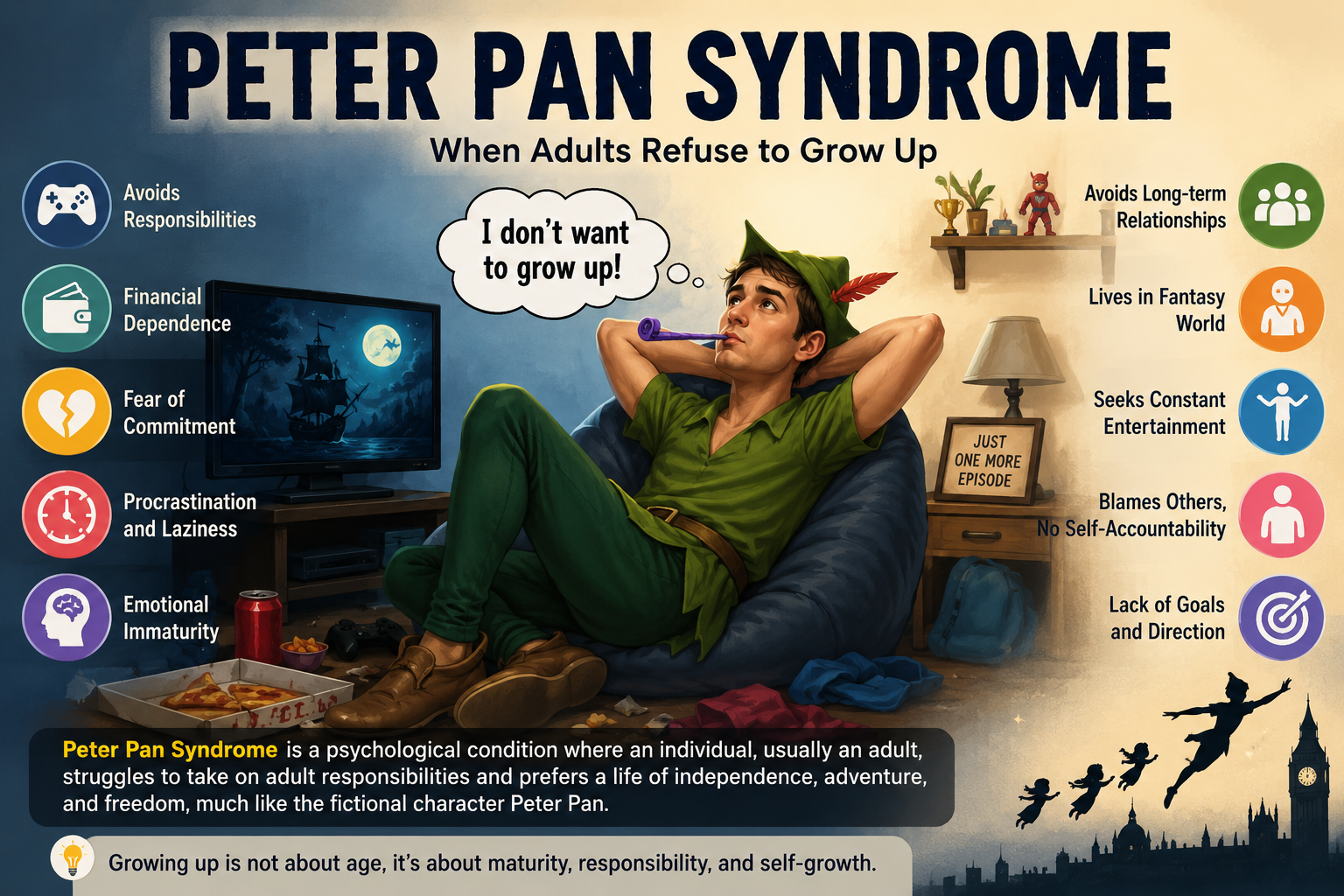
Peter Pan Syndrome refers to a pattern of emotional immaturity in adults who resist growing up. Individuals with Peter Pan Syndrome often avoid adult responsibilities such as stable employment, financial independence, marriage, parenting, or long-term commitments.
The term was popularized by psychologist Dr. Dan Kiley in his 1983 book The Peter Pan Syndrome: Men Who Have Never Grown Up. The name comes from Peter Pan, the fictional boy who never wanted to become an adult.
Although Peter Pan Syndrome mainly describes men in early literature, modern psychologists believe similar behavioral patterns may also appear among women.
Origin of the Term Peter Pan Syndrome
The idea behind Peter Pan Syndrome originates from the fictional character Peter Pan, created by Scottish author J. M. Barrie.
Peter Pan represents eternal childhood, freedom, adventure, and the refusal to enter the world of adult responsibilities. Inspired by this character, the phrase Peter Pan Syndrome became popular to describe adults who continue living psychologically as adolescents despite their biological age.
Major Characteristics of Peter Pan Syndrome
Individuals experiencing Peter Pan Syndrome often display several common traits.
1. Fear of Responsibility
People with Peter Pan Syndrome frequently avoid taking responsibility for their careers, finances, education, or family obligations.
2. Emotional Immaturity
They may react impulsively, struggle with emotional regulation, and find it difficult to manage criticism or failure.
3. Fear of Commitment
Long-term relationships, marriage, or permanent jobs often create anxiety for people experiencing Peter Pan Syndrome.
4. Financial Dependence
Many adults with Peter Pan Syndrome continue depending on parents or partners for financial support even when capable of independence.
5. Escapism
Excessive gaming, social media, entertainment, or hobbies may become ways to avoid real-life responsibilities.
6. Blaming Others
Instead of accepting personal mistakes, individuals with Peter Pan Syndrome may blame parents, employers, society, or circumstances.
Symptoms of Peter Pan Syndrome
Common symptoms include:
-
Difficulty making long-term decisions
-
Avoiding career responsibilities
-
Fear of marriage or serious relationships
-
Lack of financial planning
-
Dependence on parents
-
Poor emotional regulation
-
Avoiding difficult conversations
-
Constant search for excitement
-
Refusal to accept criticism
-
Procrastination
-
Unrealistic expectations
-
Difficulty maintaining stable employment
Not everyone displaying these behaviors has Peter Pan Syndrome, but repeated patterns over time may indicate emotional immaturity.
Causes of Peter Pan Syndrome
There is no single cause of Peter Pan Syndrome. Researchers suggest multiple contributing factors.
Overprotective Parenting
Parents who solve every problem for their children may unintentionally reduce opportunities for developing independence.
Childhood Trauma
Negative childhood experiences may make adulthood appear threatening or overwhelming.
Fear of Failure
Some individuals avoid responsibilities because they fear making mistakes.
Instant Gratification Culture
Modern digital culture encourages immediate rewards through social media, online entertainment, and gaming, making delayed gratification more difficult.
Economic Challenges
High unemployment, expensive housing, and financial insecurity may delay traditional adulthood, indirectly contributing to behaviors associated with Peter Pan Syndrome.
Peter Pan Syndrome from a Sociological Perspective
Sociologists examine Peter Pan Syndrome not simply as an individual issue but also as a product of changing social structures.
Changing Family Patterns
Parents increasingly provide financial support well into adulthood, extending dependence.
Consumer Culture
Advertising promotes youthfulness, pleasure, and entertainment, making adulthood seem less attractive.
Digital Society
Technology allows people to remain socially connected without developing deeper interpersonal responsibilities.
Delayed Marriage
Many societies now witness later marriages and delayed parenthood, changing traditional definitions of adulthood.
Economic Uncertainty
Temporary employment, gig work, and rising living costs delay financial independence, influencing behaviors often associated with Peter Pan Syndrome.
Psychological Perspective
Psychologists suggest that Peter Pan Syndrome reflects difficulties in emotional development rather than laziness alone.
Common psychological factors include:
-
Low self-confidence
-
Fear of rejection
-
Anxiety
-
Poor coping skills
-
Identity confusion
-
Emotional dependency
Since Peter Pan Syndrome is not an officially recognized psychiatric disorder, mental health professionals usually assess underlying emotional or personality issues instead.
Is Peter Pan Syndrome a Mental Disorder?
No.
Peter Pan Syndrome is not listed in major psychiatric manuals such as the DSM-5 or ICD-11.
Instead, it is considered a popular psychological concept describing patterns of emotional immaturity and avoidance of adult responsibilities.
Effects of Peter Pan Syndrome
Untreated Peter Pan Syndrome may affect several areas of life.
Personal Life
-
Low self-esteem
-
Poor life satisfaction
-
Stress
-
Anxiety
Family Relationships
-
Frequent conflicts
-
Dependence on parents
-
Relationship instability
Career
-
Frequent job changes
-
Lack of career growth
-
Poor work discipline
Society
Large numbers of emotionally dependent adults may increase economic dependence and delay social transitions into stable family and community roles.
Can Peter Pan Syndrome Be Treated?
Although Peter Pan Syndrome is not a medical diagnosis, individuals can develop greater emotional maturity through intentional effort.
Helpful approaches include:
-
Individual psychotherapy
-
Cognitive Behavioural Therapy (CBT)
-
Building emotional intelligence
-
Learning financial management
-
Taking gradual responsibility
-
Developing problem-solving skills
-
Setting realistic goals
-
Improving communication
-
Reducing unhealthy dependence
Family support and self-awareness also play significant roles.
Criticism of Peter Pan Syndrome
Some experts argue that Peter Pan Syndrome oversimplifies complex social realities.
Critics note that:
-
Economic hardship often delays adulthood.
-
Housing costs limit independence.
-
Cultural expectations vary across societies.
-
Emotional immaturity cannot always be separated from broader psychological conditions.
Therefore, sociologists recommend understanding Peter Pan Syndrome within wider social and economic contexts rather than blaming individuals alone.
Peter Pan Syndrome in Modern Society
The rise of social media, digital entertainment, online gaming, influencer culture, and changing work patterns has renewed interest in Peter Pan Syndrome.
Many young adults today experience delayed financial independence due to education costs, unstable employment, and expensive housing. Consequently, researchers increasingly explore whether modern society itself encourages prolonged adolescence.
Conclusion
Peter Pan Syndrome remains an influential concept for understanding emotional immaturity, delayed adulthood, and resistance to responsibility. While it is not an officially recognized mental illness, Peter Pan Syndrome highlights important psychological and sociological questions about growing up in the twenty-first century.
From a sociological perspective, Peter Pan Syndrome reflects not only individual personality but also changing family structures, economic uncertainty, consumer culture, and digital lifestyles. Understanding these broader influences helps create a more balanced and compassionate approach to adulthood and personal development.
Frequently Asked Questions (FAQs)
What is Peter Pan Syndrome?
Peter Pan Syndrome refers to adults who avoid responsibilities, resist emotional maturity, and fear growing up. It is a popular psychological concept rather than a medical diagnosis.
Is Peter Pan Syndrome a mental illness?
No. Peter Pan Syndrome is not officially recognized as a mental disorder in the DSM-5 or ICD-11.
What causes Peter Pan Syndrome?
Possible causes include overprotective parenting, fear of failure, emotional insecurity, childhood experiences, economic uncertainty, and cultural changes.
Can women have Peter Pan Syndrome?
Yes. Although the concept originally focused on men, similar patterns of emotional immaturity can occur in women as well.
How can someone overcome Peter Pan Syndrome?
Therapy, self-awareness, emotional development, financial independence, gradual responsibility, and healthy relationships can help individuals overcome behaviors associated with Peter Pan Syndrome.
Continue Your UPSC Journey with Sociologus
Explore our free Sociology Notes, Daily Current Affairs, PYQs, UGC NET Resources and UPSC Exam Preparation.
- Q. In what way does Queer Kinship challenge the Traditional Kinship System? Substantiate by giving Illustrations. (UPSC CSE Sociology Optional | 10 Marks)
- Q. How do Civil Society Organizations such as NGOs and Self-Help Groups contribute to Grassroot Level Social Changes? Discuss. (UPSC CSE Sociology Optional | 20 Marks)
- Q. What do you understand by Sustainable Development? Discuss the elements of Sustainable Development as proposed in the UNDP’s Sustainable Development Goals Report, 2015. (UPSC CSE Sociology Optional | 20 Marks)
- Q. What is the Nature of Relationship between Science and Religion in Modern Society? Analyze with Suitable Examples. (UPSC CSE Sociology Optional | 10 Marks)
- Q. How do Marx, Weber and Durkheim differ in Understanding Religion? Explain. (UPSC CSE Sociology Optional | 20 Marks)
sources of the posts
wikipedia
| Visit : SOCIOLOGUS.COM | |
| SOCIOLOGY THE DISCIPLINE | |
| MODERNITY | |
| 2013 ||| Paper 1 – 1a ||| “Sociology emerged in Europe and flourished to begin with on social reformist orientation in the U.S.A.” – Comment. 10 | ANSWER |
| 2016 ||| Paper 1 – 1a ||| “Sociology is pre-eminently study of modern societies.” Discuss. 10 | ANSWER |
| 2017 ||| Paper 1 – 1a ||| Explain how sociology has emerged as a distinct discipline based on rationality and scientific temper. 10 | ANSWER |
| 2020 ||| Paper 1 – 1a ||| How did the intellectual forces lead to the emergence of sociology ? Discuss. 10 | ANSWER |
| 2015 ||| Paper 1 – 3c ||| How had Enlightenment contributed to the emergence of sociology? 10 | ANSWER |
| 2022 ||| Paper 1 – 2a ||| What aspects of Enlightenment do you think paved way for the emergence of sociology? Elaborate. 20 | ANSWER |
| 2019 ||| Paper 1 – 1a ||| Discuss the historical antecedents of the emergence of Sociology as a discipline. 10 | ANSWER |
| 2024 ||| Paper 1 – 2a ||| Sociology is the product of European enlightenment and renaissance. Critically examine this statement. 20 | ANSWER |
| 2021 ||| Paper 1 – 1a ||| Europe was the first and the only place where modernity emerged. Comment. 10 | ANSWER |
| SCOPE OF SOCIOLOGY | |
| 2020 ||| Paper 1 – 5a ||| In the context of globalisation, has the scope of sociology been changing in India ? Comment. 10 | ANSWER |
| 2025 ||| Paper 1 – 5a ||| In what way is the scope of sociology unique? Explain. | ANSWER |
| OTHER SOCIAL SCIENCES | |
| ANTHROPOLOGY | |
| 2013 ||| Paper 1 – 1b ||| Compare and contrast Sociology with Anthropology. 10 | ANSWER |
| 2024 ||| Paper 1 – 1a ||| Discuss the nature of Sociology. Highlight its relationship with Social Anthropology. 10 | ANSWER |
| PSYCHOLOGY | |
| 2014 ||| Paper 1 – 1c ||| How is sociological approach to human actions different from that of psychological approach? 10 | ANSWER |
| POL SCI | |
| 2023 ||| Paper 1 – 1b ||| Discuss the relationship between Sociology and Political science. 10 | ANSWER |
| HISTORY | |
| 2010 ||| Paper 1 – 2a ||| ” Sociology without History is rootless and History without Sociology is fruitess.” Elaborate. 30 | ANSWER |
| MULTIDISCIPLINE | |
| 2017 ||| Paper 1 – 2a ||| Discuss – the changing ・equations of discipline of sociology with other social sciences. 20 | ANSWER |
| 2021 ||| Paper 1 – 2a ||| From the viewpoint of growing importance of multidisciplinarity, how do you relate sociology to other social sciences ? 20 | ANSWER |
| 2022 ||| Paper 1 – 1a ||| Delimit the scope of Sociology in relation to other social sciences. 10 | ANSWER |
| COMMON SENSE | |
| 2016 ||| Paper 1 – 2c ||| Is sociology common sense? Give reasons in support of your argument. 10 | ANSWER |
| 2021 ||| Paper 1 – 2c ||| How is sociology related to common sense ? 10 | ANSWER |
| 2023 ||| Paper 1 – 4a ||| Do you think that common sense is the starting point of social research? What are its advantages and limitations? Explain. | ANSWER |
| 2025 ||| Paper 1 – 1 a ||| What is common sense? How are common knowledge and sociology related to each other? Explain. | ANSWER |
| POLITICS AND SOCIETY { BOTH P1 &P2 } | |
| POWER ELITE | |
| 2016 ||| Paper 1 – 5b ||| Discuss the importance of ‘power elite’ in democracy. 10 | ANSWER |
| 2022 ||| Paper 2 – 6c ||| Discuss the changing natures of structure of political elites. 10 | ANSWER |
| 2018 ||| Paper 1 – 7c ||| What according to Pareto, are the basic characteristics of elites ? Discuss. 10 | ANSWER |
| 2019 ||| Paper 1 – 7c | Discuss the concept of circulation of elite. 10 Marks | ANSWER |
| 2019 ||| Paper 1 – 6b ||| What are the theoretical models of societal power ? Which one of them is most applicable in advanced industrial societies ? 20 | ANSWER |
| 2020 ||| Paper 1 – 6b ||| According to Mills, “Elites rule in institutional terms rather than psychological terms.” Comment. 20 | ANSWER |
| 2021 ||| Paper 1 – 5b ||| Critically examine the relevance of Vilfredo Pareto’s theory of Circulation of Elites in the present scenario. 10 | ANSWER |
| 2023 ||| Paper 1 – 2a ||| What, according to Robert Michels, is the iron law of oligarchy? Do lions and foxes in Vilfredo Pareto’s theory, essentially differ from each other? Substantiate | ANSWER |
| SOCIOLOGICAL THEORIES OF POWER | |
| 2014 ||| Paper 1 – 6a ||| “Power is not a zero-sum game.” Discuss with reference to Weber’s and Parsons’ views. 20 | ANSWER |